
Last updated November 17, 2026
 AC repair
 Furnace & heating
 Heat pumps
 Ductless mini splits
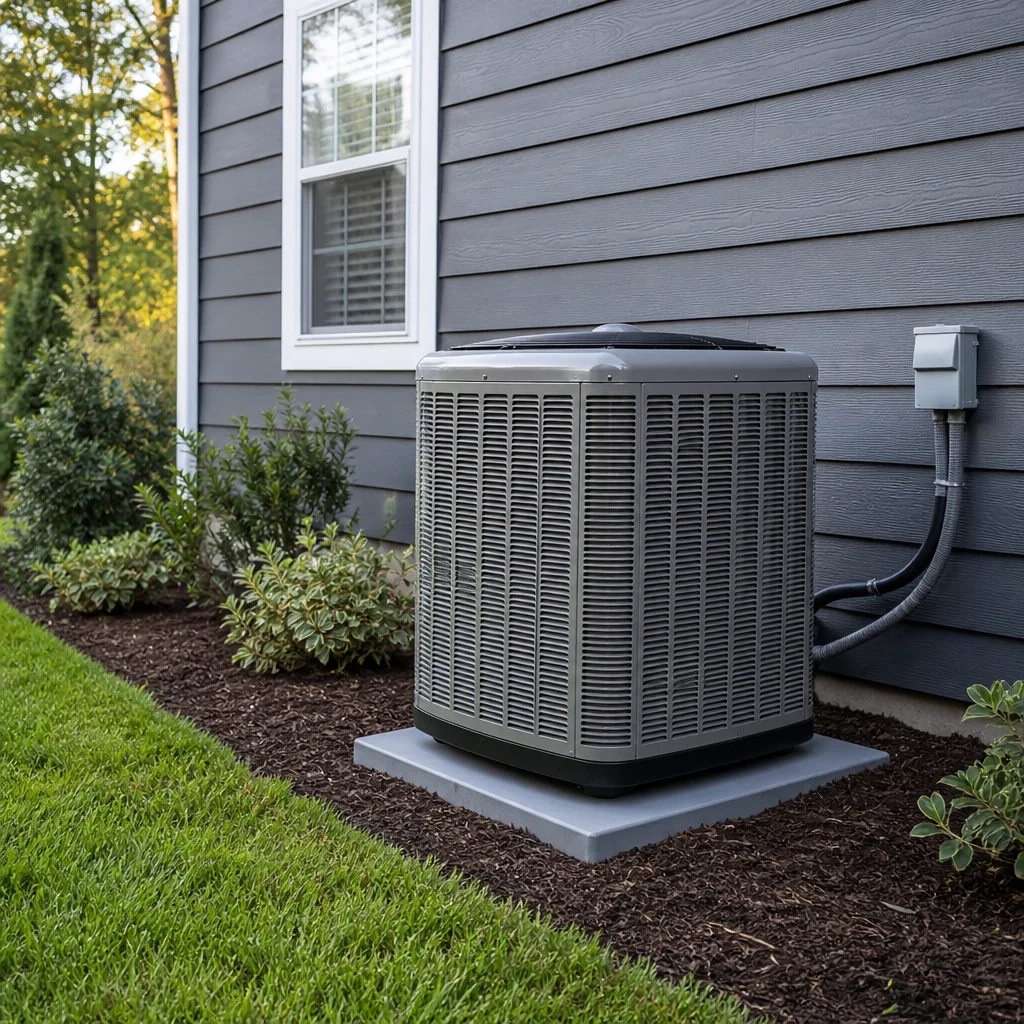 Carrier
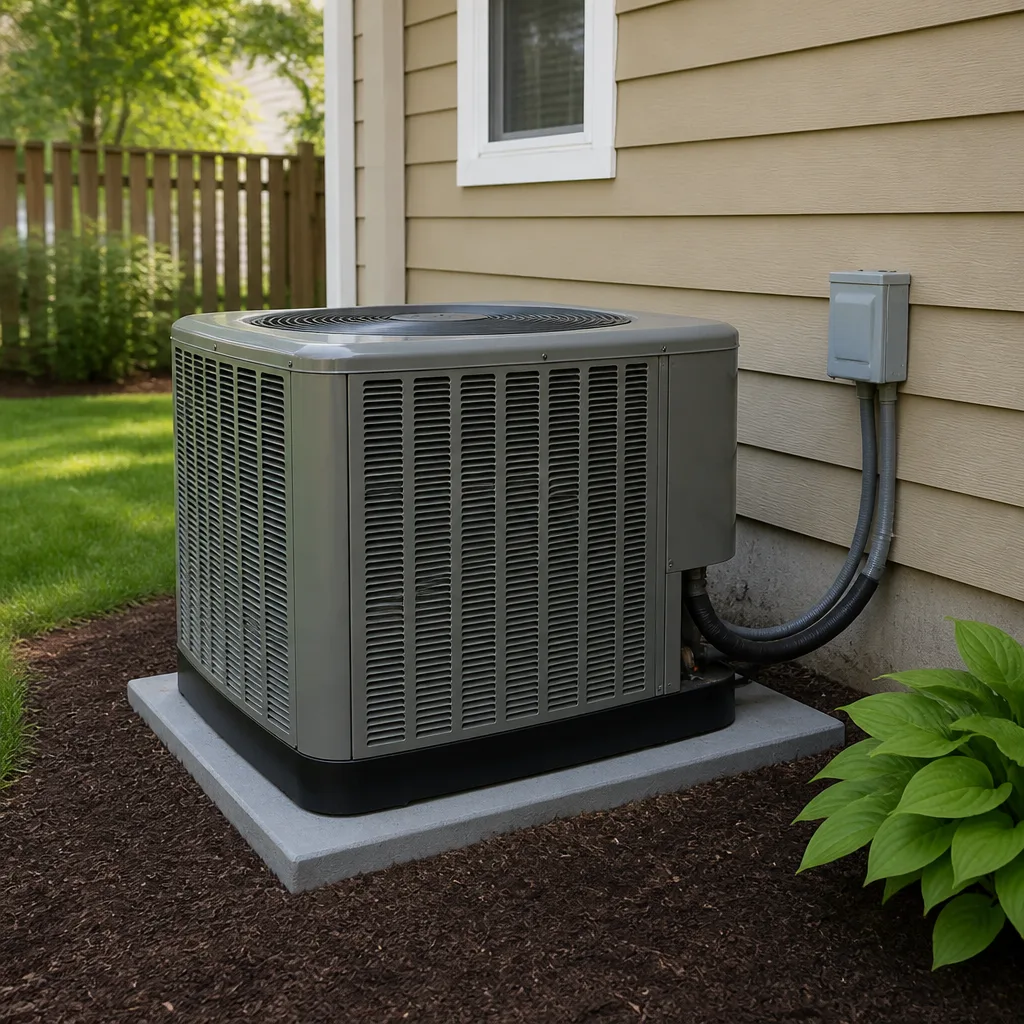 Trane
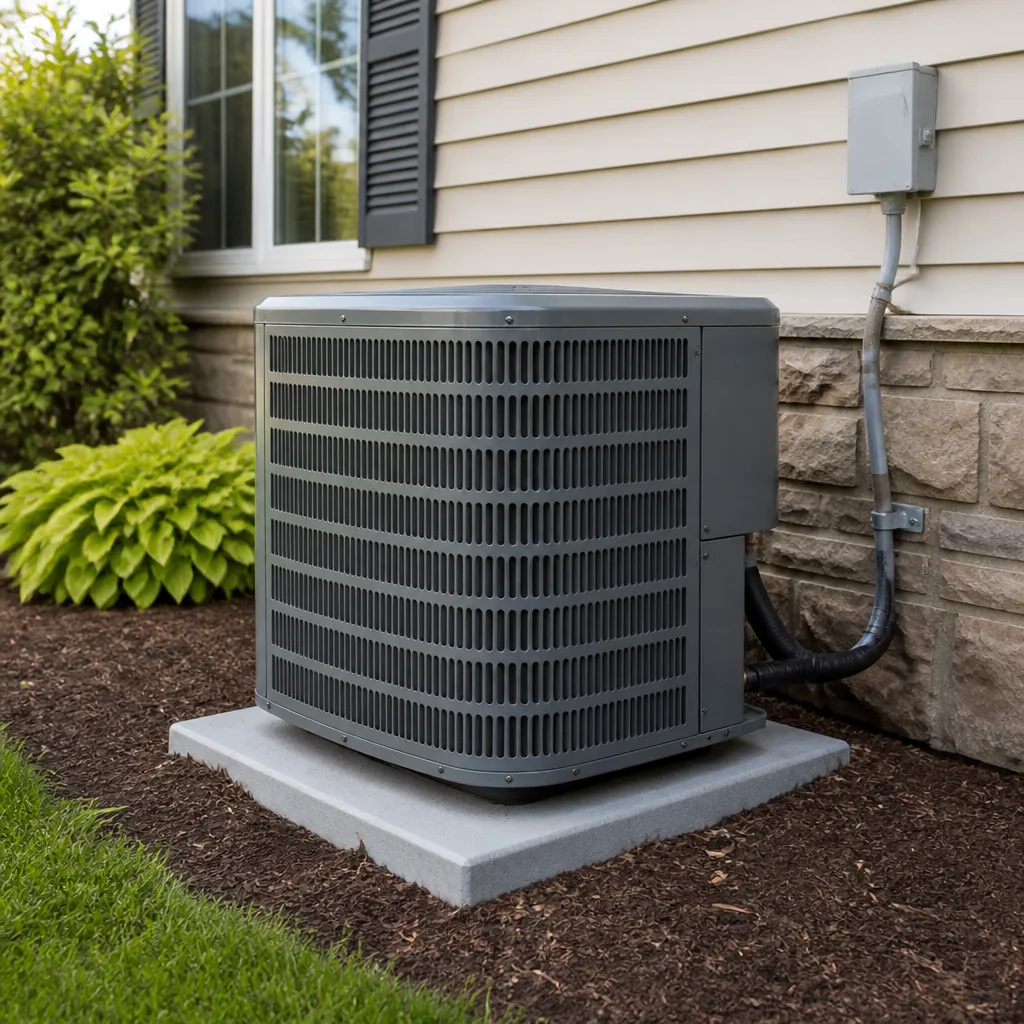 Goodman
Seasonal tune-up and full diagnostic on your Carrier, Trane, or Goodman system - readings shown to you before any repair is proposed
Diagnosis first, numbers second - you approve the repair price before a single part goes in.
Get your free estimateEmergency & Commercial HVAC Maintenance Schedule: What to Do and When
A commercial building in Summerlin can log in five months the cooling hours a Chicago building takes nine months to reach. The compressor, the fans, the contactors, the condenser coils: they’re all running roughly double the annual duty cycle the manufacturer assumed when it printed its maintenance chart. And yet most service contracts still schedule visits by calendar date, not by actual run-hours. That’s the equivalent of changing the oil once a year on a long-haul truck. This guide explains how to recalibrate a commercial HVAC maintenance schedule for Summerlin’s heat, dust, and operating load, what to do season by season, and how to keep records that make warranty claims and 2 a.m. troubleshooting go faster.
Quick Answer
For commercial equipment in Summerlin, treat the calendar as a starting point and shorten it by 25 to 40 percent based on actual run-hours, supply it with quarterly rather than annual condenser coil cleaning, and add a mid-summer inspection that most manufacturer schedules don’t include. Pre-peak cooling (March – April), mid-summer (July), and post-season (October) are the three checkpoints that matter most. Emergency-only maintenance is a false economy here; the environment is too punishing.
Styles & brands we work with
- AC repair
- Furnace & heating
- Heat pumps
- Ductless mini splits
- Carrier
- Trane
- Goodman
Table of Contents
- Why Manufacturer Schedules Fall Short in Summerlin
- How to Adjust Intervals Using Actual Run-Hour Tracking
- The Three Seasonal Checkpoints That Matter Most
- Which Tasks Are Genuinely Quarterly Versus Annual
- What a Summerlin-Appropriate Service Contract Should Include
- Building an Equipment Log That Speeds Up Emergencies
- How Maintenance Records Protect Your Warranty
- Emergency Readiness: What to Have Ready Before Something Fails
Why Manufacturer Schedules Fall Short in Summerlin
Every manufacturer we service – Carrier, Trane, American Standard, Bryant – writes its recommended maintenance intervals for average operating conditions. Average means roughly 1,400 to 1,600 cooling hours a year, moderate dust loading, and ambient temperatures that peak in the high 80s. Summerlin operates at the opposite end of nearly every variable. Cooling season runs from late April through early October. Design-day temperatures push 105°F or higher. And the air carries a fine desert particulate that loads condenser coils faster than the manufacturer’s “clean annually” baseline anticipates.
This is not marketing hand-waving. It’s thermal reality. A condenser coil with a 30 percent dust load has to work harder to reject the same amount of heat, which raises head pressure, which strains the compressor, which shortens the equipment’s service life. The same coil in a low-dust climate might reach that 30 percent load in 18 months. In Summerlin, we regularly see it at 12 or less.
Commercial systems also tend to run nearly continuously during peak season in a way residential systems don’t. A rooftop unit serving a retail space that opens at 9 and closes at 9, seven days a week, is at full load about 70 hours a week during the hottest stretch. Track that against a standard quarterly visit and the math gets uncomfortable. The manufacturer intended four visits a year. The building may need six.
The practical takeaway is not to throw out the manufacturer’s chart. It’s to shorten the intervals that the environment punishes most: coil cleaning, filter changes, and refrigerant charge verification. And to add at least one additional inspection during the peak cooling window, when failure carries the highest cost.
How to Adjust Intervals Using Actual Run-Hour Tracking
Run-hour tracking turns a generic maintenance calendar into a schedule built around your equipment’s actual work. Every commercial system has a way to capture this, even if it’s just a service technician reading a controller’s runtime counter on each visit.
Here’s the process we use to calibrate a Summerlin commercial schedule:
- Record baseline run-hours for one full season. Read the hourly meter (or pull the runtime log from the building automation system) at the start and end of the cooling season. That’s the load the equipment actually carries.
- Divide by manufacturer interval. If Carrier calls for annual coil cleaning at 1,500 cooling hours and your system logs 3,200, the interval shortens in proportion, roughly to every six months.
- Adjust for dust and ambient. Add another 20 to 30 percent shortening in Summerlin because of particulate loading. Coil cleaning that the manufacturer intends once a year on an office building becomes quarterly in a building near open desert on the west side.
- Flag the high-stress items. Compressors, condenser fan motors, and contactors are the components run-hours eat fastest. Those get the additional mid-summer inspection; blower motors and belts can usually stay on the standard cycle.
- Review at the end of each season. Run-hours change as tenant loads change. A schedule built on 2019 numbers is fine until the building switches to 24-hour operation and everything shifts. Recheck every spring.
This is where a written equipment log does real work: without run-hour history you’re guessing. With it, you’re sizing the maintenance to the equipment instead of the equipment to the calendar. For buildings we service through Fireside Heating & Air Co. Summerlin home, this tracking is part of the tune-up visit and gets recorded so next year’s schedule starts from data, not assumptions.
The Three Seasonal Checkpoints That Matter Most
Coastal climates get away with loose maintenance because the worst-case supply air is rarely more than 20 degrees below ambient. Summerlin doesn’t. When the outside temperature is 108°F and the equipment is asked to deliver 55°F supply air, every weak link shows up at once – dirty coils, low refrigerant, restricted airflow, failing capacitors. The seasonal checkpoints are designed to catch those failures before the hottest week of the year.
Pre-peak cooling (late March to mid-April)
This is the single most important visit of the year. The objective: confirm the system is fully ready for the load it’s about to see for five solid months. Clean condenser and evaporator coils. Replace filters. Check refrigerant charge against manufacturer spec. Verify contactor condition, capacitor values, and amp draw. Belt tension and blower alignment. Clear condensate drains and confirm the float switch works. This is also the time to test controls and economizer dampers for buildings that use them.
Mid-summer (July)
Most boilerplate service contracts don’t include a summer visit because the manufacturer template only has spring and fall. In Summerlin, that’s the wrong call. The mid-summer inspection catches what pre-peak couldn’t: condenser coils re-loaded with dust over 90 days of continuous operation, filters plugged, refrigerant that has slowly leaked since spring, and any component that is running hot. A half-day visit in July regularly saves a five-figure emergency chiller or RTU replacement in August.
Post-season (October)
Post-season is about documenting and preserving. Record final run-hours for the year, note anomalies, and file photos of coil condition before and after. Clean the equipment to reduce corrosion over winter. Verify heating operation for dual-fuel and heat-pump systems. Tighten electrical connections that vibration has loosened over the season. For buildings with cool-season loads, switch the maintenance emphasis to heating components and check the furnace or heat-pump side of the system in line with our Heating & Furnace in Summerlin service. This visit is the one that validates warranty compliance at year-end.
Which Tasks Are Genuinely Quarterly Versus Annual
Most maintenance lists treat every task as either “annual” or “as needed.” That’s the wrong split for Summerlin. Here’s roughly how tasks shake out when the climate is honest with them:
Genuinely quarterly in Summerlin
- Condenser coil cleaning (in dusty areas, sometimes every 60 days during peak season)
- Filter replacement (every 60 – 90 days; more often on a building with any outdoor loading)
- Condensate drain clearing
- Refrigerant pressure and charge spot-check
- Thermostat and sequence-of-operation verification
Twice yearly
- Belt condition and tension (or annual on direct-drive units)
- Blower wheel inspection and cleaning
- Contactor and capacitor testing
- Economizer linkage and damper operation
Annual (or seasonally at minimum)
- Full electrical connection torque check
- Compressor amp draw analysis and winding resistance
- Ductwork leakage and insulation inspection
- Crankcase heater and low-ambient control function test
- Refrigerant leak detection across the full circuit
Tasks on the annual list are still worth doing every year, but skipping a year is survivable. Tasks on the quarterly list are not. Filter and coil problems cascade directly into compressor load, and Summerlin compressors run close enough to design limits that they don’t tolerate the cascade. For buildings with heat pumps or ductless splits, similar thinking applies – check our Heat Pump & Mini Split in Summerlin page for the specifics on those systems.
What a Summerlin-Appropriate Service Contract Should Include
Most commercial maintenance agreements we’re asked to review are boilerplate. Two visits a year, a task list written for a Chicago office building, and an emergency response clause that sounds good until you need it. A Summerlin-appropriate contract looks different.
- At least three scheduled visits, not two, with the mid-summer inspection spelled out.
- Quarterly coil cleaning as an included line item. Not “annual cleaning, additional as needed.”
- Filter changes included, not billed separately as a materials surcharge.
- Refrigerant charge verification at every visit, with readings logged in writing.
- Run-hour tracking documented by the technician each visit, with next year’s interval adjustment noted.
- Response-time commitment for emergency callbacks – a defined window, not “as soon as possible.”
- Photographic documentation of coil condition and equipment condition at every visit.
- A written report after each visit – what was found, what was done, what needs follow-up.
- Pricing that is fixed per visit, not a per-hour rate that changes when the truck rolls.
If a proposed contract doesn’t include at least quarterly coil cleaning, a mid-summer visit, and documentation you can hand to a warranty administrator, it isn’t calibrated to Summerlin. It’s the manufacturer’s chart wearing a Summerlin label. When we quote a maintenance agreement through AC Repair & Installation in Summerlin, coil cleaning frequency and visit count are set by run-hours, not by the boilerplate.
Building an Equipment Log That Speeds Up Emergencies
The equipment log is the single most overlooked document in commercial HVAC. Properly kept, it turns a 2 a.m. service call into a 90-minute diagnosis instead of an all-night investigation. Poorly kept, it turns every emergency into a fresh start.
A useful log has these fields for each piece of equipment:
- Nameplate data. Manufacturer (Carrier, Trane, American Standard, Bryant, and so on), model, serial, refrigerant type, capacity, and install date.
- Warranty terms. Start date, labor and parts coverage, and what documentation the administrator requires for a claim.
- Service history. Every visit, every part replaced, every reading taken. Dated and signed.
- Run-hours by season. Cumulative hours each cooling season and heating season, with the meter reading the technician captured.
- Refrigerant log. Every charge addition, every leak detected, every recovery – dated and quantified.
- Photos. One of the data plate, one of the coil before and after cleaning, one of the electrical compartment each visit.
The log’s biggest payoff is at the warranty desk. When a compressor fails at year five and the claim hinges on whether maintenance was performed “per manufacturer recommendations,” a documented service history with dated visits, run-hour notes, and coil photos is the difference between a paid claim and an argument. Without the log, the administrator asks you to prove it and you can’t. With it, you hand over the file and the claim moves.
Emergency troubleshooting also gets real speed from the log. A technician arriving at night with no history has to test everything from scratch. With the log, the technician sees that the unit was washed in July, that refrigerant was added in August with a note about a suspected leak at the service valve, and the diagnosis is halfway there before the gauges go on.
How Maintenance Records Protect Your Warranty
Nearly every commercial HVAC manufacturer conditions its parts warranty on maintenance performed at the recommended intervals. That’s a phrase most facility managers read past until they need the warranty. Then the fine print about “proof of maintenance” becomes the sticking point.
What the administrator wants to see is documentation that the equipment was serviced as specified. In practice that means dated invoices showing what was done, coil cleaning records, refrigerant logs, and filter change history. The specific chart in the manufacturer’s literature is the reference point – if the chart says annual coil cleaning and your records show quarterly, that satisfies the requirement. If the records show nothing, the claim stalls regardless of how clean the coil actually was.
The other way records protect you is by documenting an operational issue before it becomes a warranty dispute. A commercial Summerlin system that consistently runs high head pressure during July is a system the log will show failing incrementally, visit by visit, with refrigerant added and coils washed and amps recorded. When the compressor finally gives out, that documented pattern of stress is not the maintenance provider’s fault and the claim is easier to sort out. Without records, everyone points at everyone else.
For buildings where commercial replacement is under discussion, records also inform the replacement decision. A log showing consistent refrigerant loss, recurring coil failures, and near-yearly compressor stress tells you what a new unit would actually buy you. That’s the same straight talk we apply to residential replacement on our AC installation page – repair versus replace is a documentation question as much as a price question.
Emergency Readiness: What to Have Ready Before Something Fails
There is no maintenance schedule that eliminates emergency calls in Summerlin. Five months of 100°F-plus operation will eventually catch a component. Getting ready for that day is a maintenance task, not a fire drill. What to have prepared:
- A single call number that a live person answers around the clock. Voicemail trees are useless at 2 a.m.
- Model and serial numbers for every piece of equipment, taped inside the door of the unit and stored in the office.
- The equipment log, current within the last visit.
- A short list of what you actually observed when the system failed – sounds, smells, error codes, outdoor temperature – which saves a diagnostic hour on scene.
- A record of the last refrigerant readings, so the technician starts from a known baseline.
- A written list of which equipment serves which tenant or space, so a partial system failure doesn’t take down the whole building.
When a system does fail, call. That’s the whole protocol. We answer every call with a live person, 24 hours a day, seven days a week, and the price we quote is the price you pay – no after-hours surprises on the invoice. For the smaller heating and cooling systems common in adjacent commercial spaces, our furnace and heating service and heat pump and mini-split service work from the same schedule logic.
Common Mistakes to Avoid
- Following the manufacturer’s calendar without adjusting for Summerlin. The chart was written for average conditions. This isn’t average. Shorten the intervals the environment punishes most, and add the mid-summer visit.
- Skipping the mid-summer inspection. Two-visit-a-year contracts feel adequate because they match the manufacturer template. In Summerlin, the July visit prevents far more failures than the October visit catches.
- Treating refrigerant top-offs as maintenance. Adding refrigerant without finding the leak is postponing a compressor replacement. Every addition belongs in the log with a leak-detection note.
- Filter changes on the “as needed” plan. Filters are cheap. Compressors are not. A commercial Summerlin building should have filters on a fixed 60-to-90-day rotation, not a “when someone remembers” rotation.
- No written run-hour record. Without it, calibration is guesswork. With it, the whole schedule becomes sized to the actual load.
- Contract language that leaves coil cleaning “as needed.” “As needed” in Summerlin means “after the coil is already loaded.” Quarterly is the correct baseline; anything looser is a decision to under-maintain.
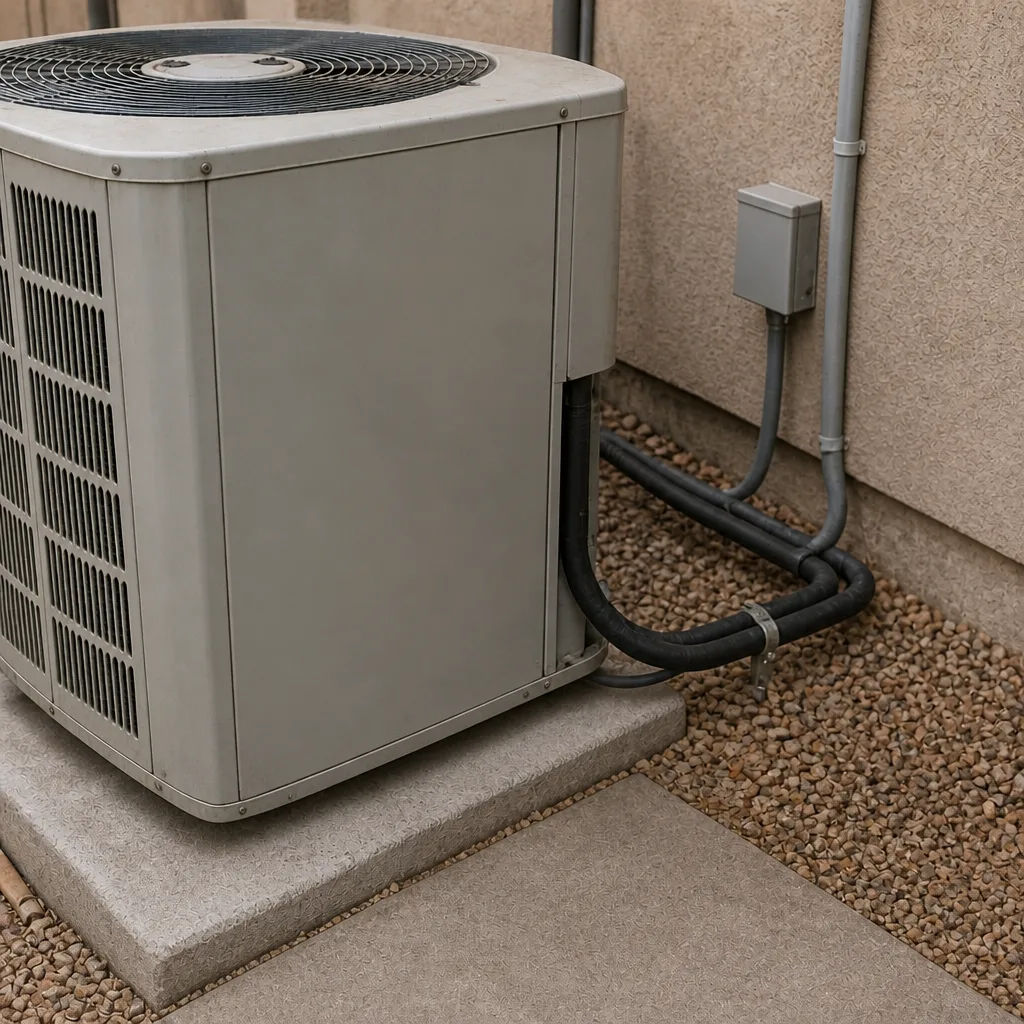
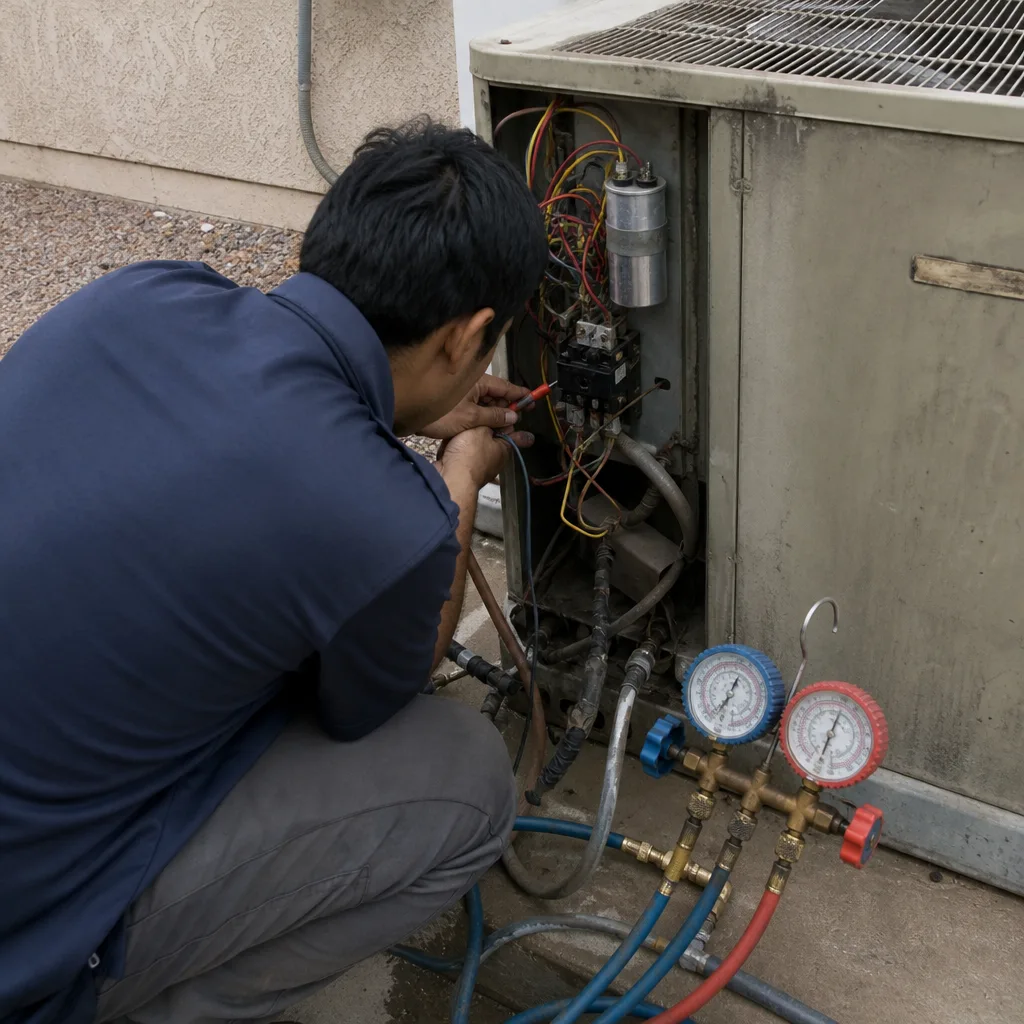
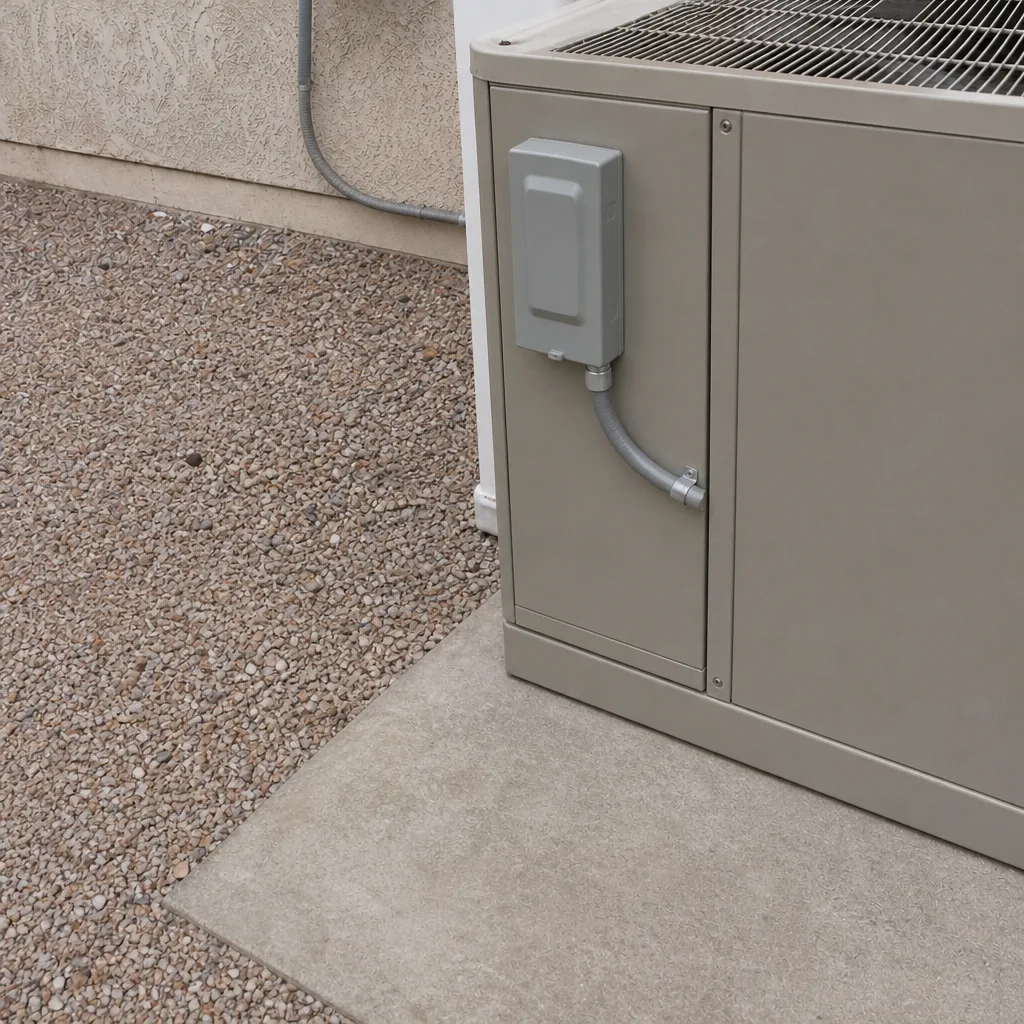
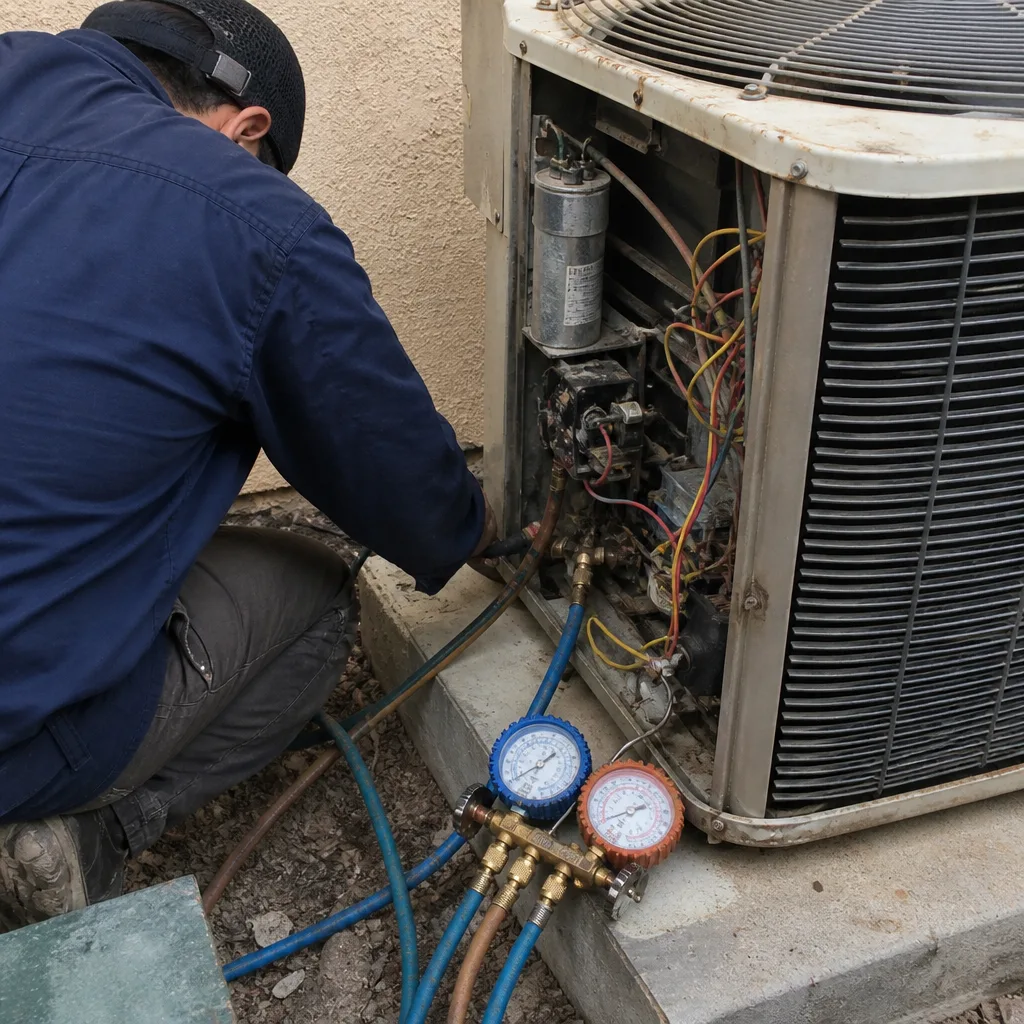
- No photographic documentation. Photos of coil condition and electrical compartments are free and win warranty claims. Take them every visit.
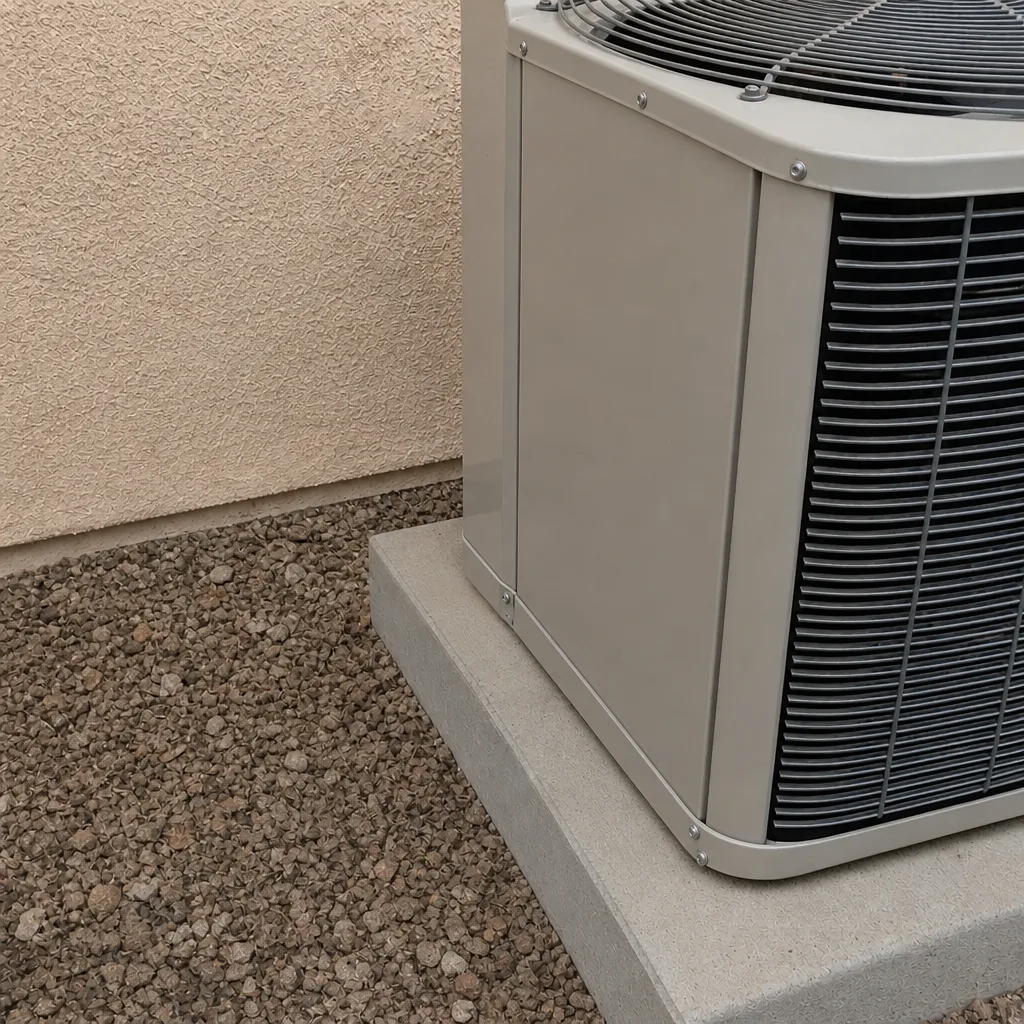
See the difference
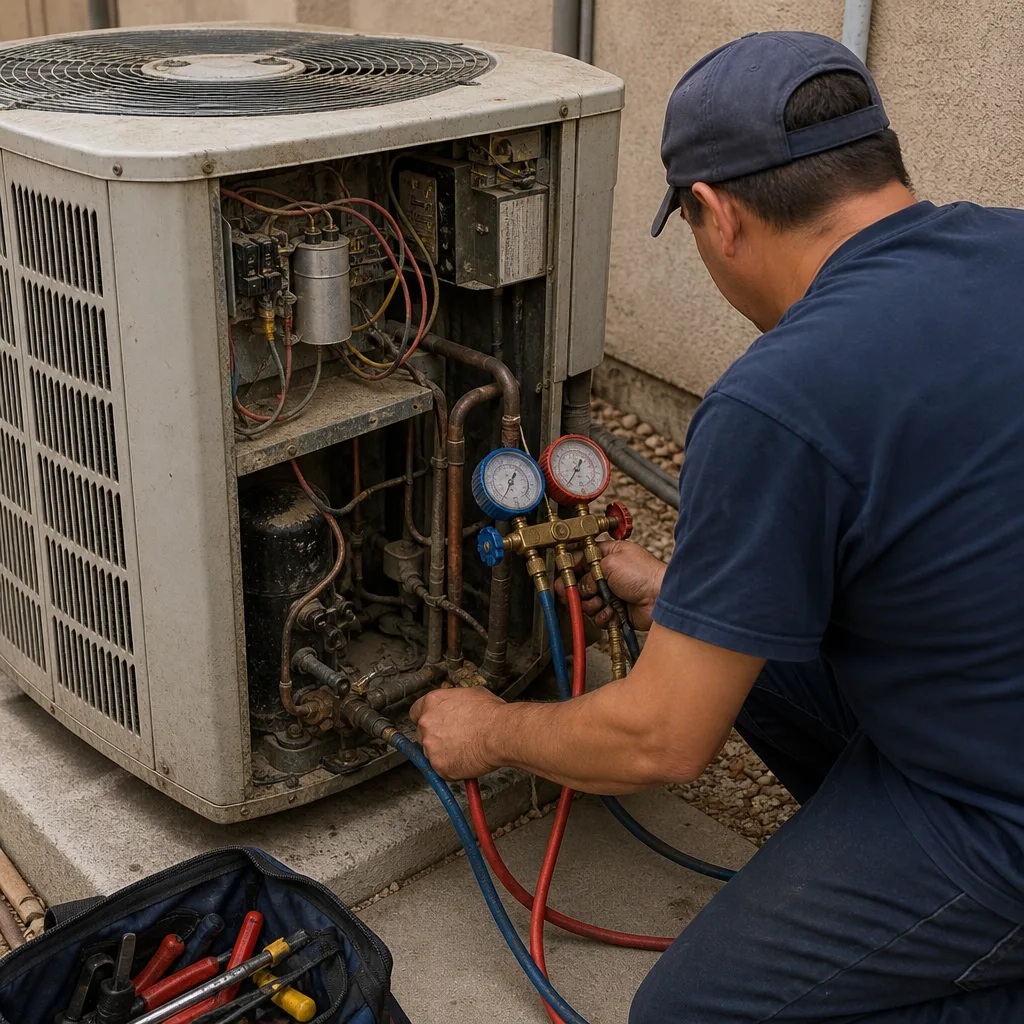 Before
 After
 Before
 After
 Before
 After
When to Call a Professional
Call for anything that involves refrigerant circuits, electrical panels, compressor components, or gas-fired heating equipment. These are genuinely dangerous systems – pressurized refrigerant causes frostbite and can displace oxygen in a confined space, panel work can kill, and gas leaks are an immediate hazard. That’s not a project for a building maintenance crew with the best of intentions. Call for any compressor issue, any repeated breaker trip or fuse failure, any refrigerant smell or visible oil trace at a fitting, any suspicious noise from the condensing unit, any high-head-pressure condition, and any heating equipment that smells of gas or won’t ignite cleanly.
Fireside Heating & Air Co. Summerlin offers free estimates in Summerlin – call (888) 325-9387. We’re reachable 24 hours a day, every day, and our background-checked, uniformed technicians are trained on the nine major brands, including Carrier, Trane, American Standard, and Bryant. Our technicians have up to 8 years of experience, and every job is backed by our 90-Day Done Right Promise: if it isn’t done right, we make it right, in writing, no arguing.
Frequently Asked Questions
Three scheduled visits a year is the right baseline for Summerlin commercial equipment: pre-peak in March – April, mid-summer in July, and post-season in October. That’s one more than most manufacturer schedules recommend because the environment here racks up cooling hours faster than average conditions. Buildings running near 24-hour operation may need four visits.
No. Annual coil cleaning is not sufficient in Summerlin’s dust and heat. Quarterly is the correct interval for most commercial equipment here, and every-60-days during peak season for buildings near open desert on the west side. A condenser coil that loads with dust raises head pressure and shortens compressor life; cleaning is the cheapest compressor protection available.
The manufacturer’s chart is a starting point, not a final schedule. It was written for average operating conditions that don’t match Summerlin’s five-month cooling season and high ambient temperatures. Adjust intervals using actual run-hours and dust loading, and add the mid-summer visit that the standard chart omits. Our team will review the chart against your building’s run-hour data and quote a fixed-price plan calibrated to it.
Emergency calls happen when equipment fails and there is no cooling or heating. Scheduled maintenance is planned and priced in advance. We answer emergency calls 24 hours a day, every day, with a live person, and the price quoted is the price paid – no after-hours surcharge surprises. Call (888) 325-9387 any time and we’ll tell you what to expect.
Yes. Nearly every commercial HVAC manufacturer conditions its parts warranty on documented maintenance performed at recommended intervals. A log with dated visits, coil photos, refrigerant readings, and run-hour notes satisfies that requirement. Without records, an administrator can delay or deny a claim on the grounds that maintenance wasn’t proven. The log is the file you hand over.
Quarterly condenser coil cleaning during the cooling season. Everything else in the maintenance book matters, but no other single task protects the compressor as directly. Dirty coils are the most common root cause we find when a commercial compressor fails in Summerlin. Pair coil cleaning with filter rotation and a documented refrigerant charge check, and you’ve addressed most of the failure modes this climate drives.
The Bottom Line
Summerlin’s commercial HVAC maintenance realities don’t fit neatly into a manufacturer’s two-visit-a-year template. The climate demands more frequent coil cleaning, a mid-summer inspection that most schedules skip, run-hour based interval adjustments, and documentation thorough enough to satisfy a warranty administrator at year five. Get those pieces right and the cost of maintenance is far lower than the cost of the emergency visits it prevents. We’ve been doing this work in Summerlin for over 42 years, and the buildings that hold up best are the ones with a written schedule on the wall and a running log in the office.
If your current service contract wasn’t written for a Summerlin building, call (888) 325-9387 for a free estimate. We’ll answer with a live person, review your equipment run-hours, and quote a fixed price for a schedule that fits the climate. The price quoted is the price paid, the work is backed in writing for 90 days, and if it’s not done right, we make it right – no paperwork, no arguing.
Written by the team at Fireside Heating & Air Co. Summerlin.