
Heat Pump & Mini Split: Repair or Replace? How Summerlin Homeowners Decide
A mini split rated to 115°F ambient is running at the edge of its design limit on a typical Summerlin July afternoon, and most homeowners don’t know that limit exists until something fails. Here’s the short answer: in Summerlin, a mini split under about eight years old with a healthy compressor and no refrigerant leaks is almost always worth repairing. Past ten years, with a failed compressor or a leaking coil, replacement usually wins. The trouble is that “about eight years” hides a lot, because in this heat, a unit’s real age and its calendar age are two different things.
If you’d rather have someone look at yours than read another guide, call (888) 325-9387. A live person answers, day or night, and estimates are free.
What “High Ambient Rated” Actually Means for Your Mini Split
Every mini split has an operating ceiling, and it’s printed in the spec sheet, not on the box. That ceiling is the outdoor temperature above which the unit can no longer reject heat efficiently. Most standard residential mini splits are rated to somewhere between 104°F and 115°F. Some “high ambient” models stretch to 122°F, usually at a cost premium and often with a derated capacity number attached.
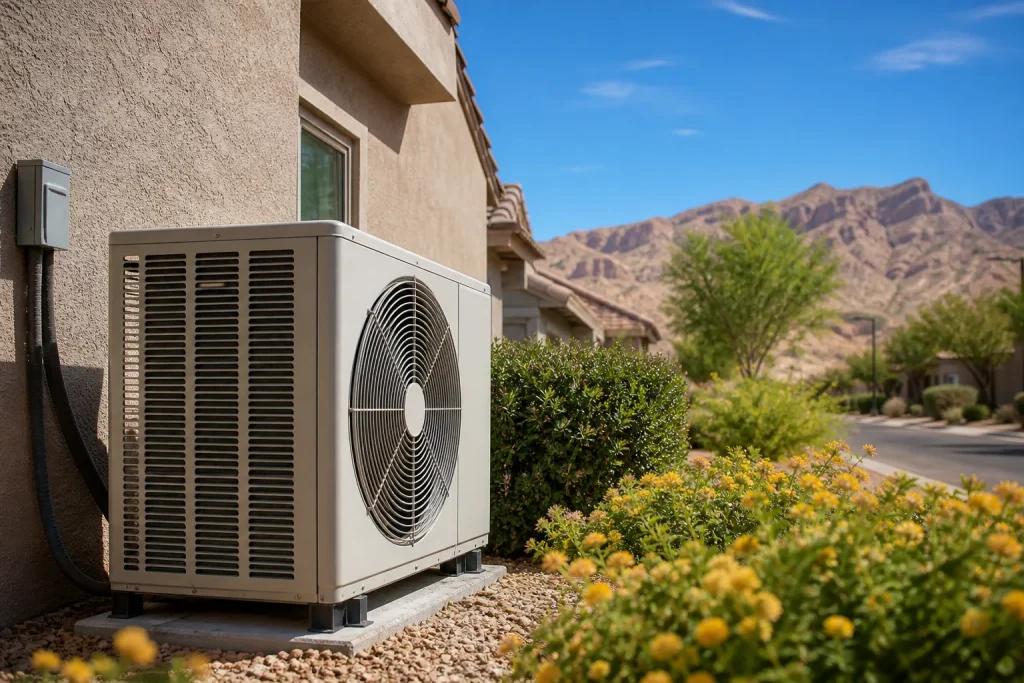
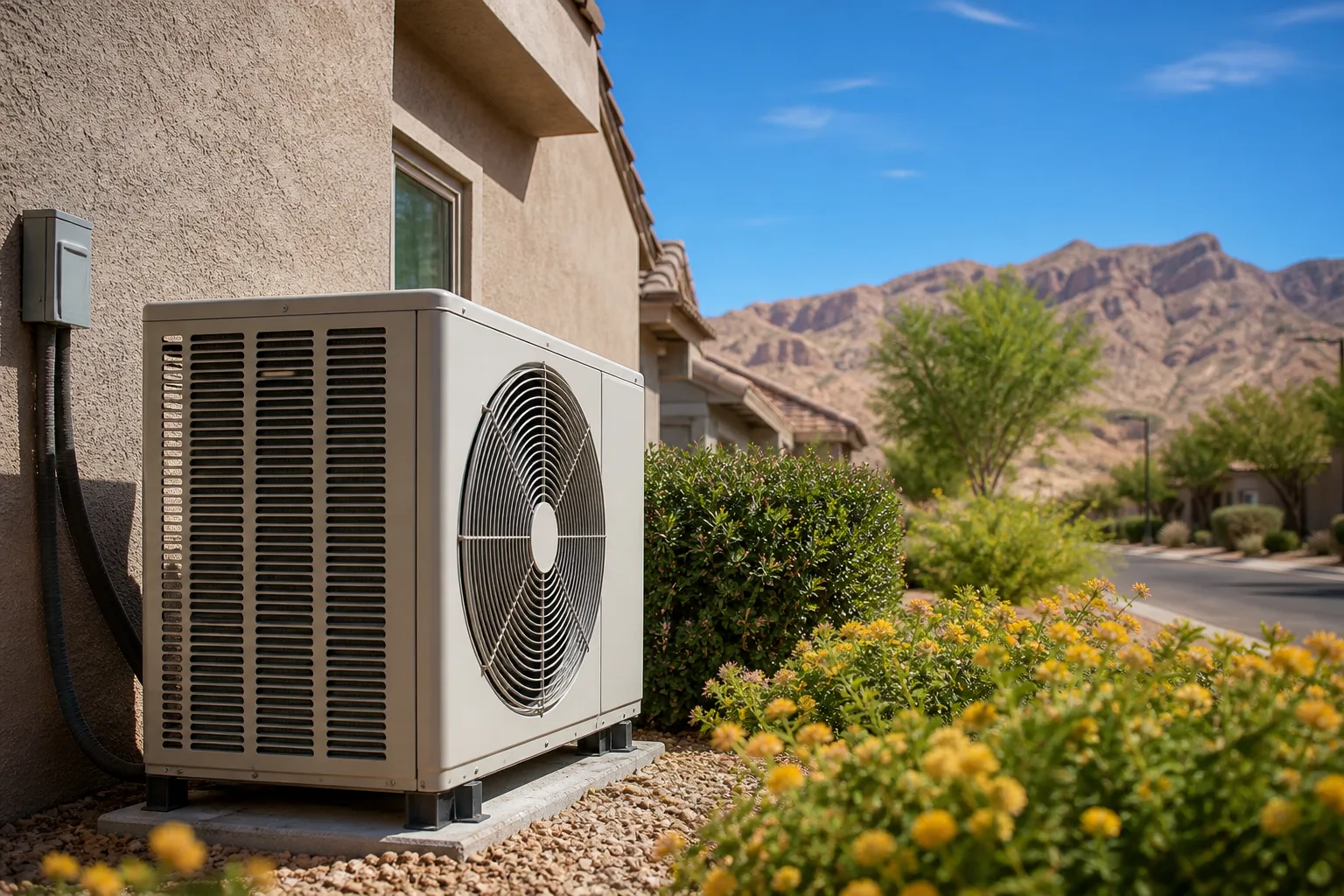
Why this matters in Summerlin specifically: a July afternoon on the west side of the valley regularly sits between 108°F and 112°F, and a unit mounted against a stucco wall in direct sun can see ten degrees more than the air temperature. A mini split rated to 115°F that’s baking at 120°F isn’t broken. It’s over its ceiling, and it’s protecting itself.
How to find your model’s true limit:
- Look up the model number on the outdoor unit’s data plate, then pull the manufacturer’s spec sheet online. Look for “maximum outdoor ambient” or “operating range.”
- Check the capacity table, not just the max. A unit rated to 115°F may only deliver 70% of its rated BTU at that temperature, which explains a room that can’t keep up in August even though the system “works.”
- Note where the outdoor unit sits. A unit in a shaded breezeway in The Ridges runs cooler than one on a bare south-facing wall in Red Rock Country Club. Placement affects the effective ceiling as much as the spec sheet does.
When a unit runs at or above its ceiling for weeks at a time, it doesn’t fail all at once. It ages faster than the rating assumes. That’s the pattern we see in Summerlin mini splits, and it’s why the repair-or-replace call here is more time-sensitive than most guides let on.
The Failure Modes We See in Summerlin Mini Splits After Year Six
Run any inverter-driven system past its ambient limit for a few summers and a predictable set of parts starts to go. These are the three we see most on Summerlin systems once they cross the six- or seven-year mark:
- Compressor over-temperature shutoff. The compressor’s internal thermal protector trips, the system cuts out, and it comes back on when it cools. At first this happens once in a heat wave. Later it happens most afternoons. Homeowners often describe it as “it works fine in the morning.”
- Thermal expansion valve drift. The TXV meters refrigerant into the coil. Under sustained high head pressure it drifts out of calibration, so you get reduced capacity and a system that seems to run forever without satisfying the thermostat. It’s a common and very fixable failure.
- Control board degradation. Heat is hard on capacitors and board-mounted components. Inverter boards in particular live in the outdoor unit, in the sun, and they cook. A board failure can look identical to a compressor failure from the thermostat, which is exactly why a proper diagnosis matters before anyone quotes you a new system.
We pulled a board out of a unit in Summerlin last week that had a heat-stained capacitor and a compressor that tested perfect. The homeowner had been told elsewhere the whole system was done. It wasn’t. One board, one afternoon, and it’s cooling like it should.
Why a Mini Split Quote Without a Refrigerant Evaluation Is Incomplete
In a mild climate you can sometimes get away with guessing. In the desert you can’t. Any repair quote for a Summerlin mini split that doesn’t include an actual refrigerant-side evaluation is missing half the picture, and you should ask why.
What that evaluation should include:
- Superheat and subcooling readings, taken at the ports, not estimated. These tell you whether the system is properly charged and whether the metering device is doing its job.
- A static leak check or at minimum an electronic leak search on the flare connections and coil ends, since flare joints are the most common leak point on a wall-mounted system.
- A head pressure reading at operating temperature, which is how you confirm the compressor is pumping and the condenser is rejecting heat. A compressor can run, sound normal, and still be weak. Pressures tell you.
- An amp draw comparison against the compressor’s rated draw. High amps plus low capacity means a failing compressor. Normal amps plus low capacity usually points upstream to the valve or charge.
Skipping these steps is how homeowners end up paying for a compressor that wasn’t the problem. It’s also how a genuinely failing compressor gets “repaired” three times before someone finally reads the pressures. Our team has up to 8 years of technician experience on these systems, and the pressures are always the first thing we look at. Repair or replace is a conclusion, not a starting point.
The Inverter Board Question: Repair the Board, Keep the Compressor
Here’s where mini splits and conventional systems make different decisions. An inverter compressor is variable-speed and electronically driven, which means a control board failure doesn’t automatically mean the compressor is bad. The two are separate components, and often only one has failed.
If the compressor tests healthy (good pressures, correct amp draw, no winding fault) and the board is the failed part, replacing the board on a good compressor frequently makes more sense than a full unit swap. You’re keeping the most expensive component in the system and replacing the part that actually failed. We’ve seen this save Summerlin homeowners thousands on units that still had years of service left. We’ve seen the same job go the other way when the compressor was already running weak, and replacing a board on a dying compressor just delays the inevitable.
That’s the whole decision in one line: the board is worth replacing if the compressor underneath it is sound. The only way to know is pressure and amp testing, and any company that won’t do that before recommending a full replacement is asking you to guess.
For more on how we approach these systems, see our Heat Pump & Mini Split in Summerlin page.
How to Judge Remaining Useful Life by Runtime, Not Just Age
A ten-year-old mini split used four months a year is not the same as a ten-year-old mini split that runs March through November because it also handles shoulder-season heating. In Summerlin, many systems run most of the year, and that’s a lot of compressor hours. Calendar age tells you almost nothing on its own. Runtime does.
Before we recommend either path, here’s what we look at:
- Compressor run hours and cycle frequency where the system logs it, or a reasonable estimate from the thermostat history. Long run times at high ambient mean more wear per year.
- Pressure and amp readings under load, taken on a hot afternoon if possible. A system tested at 85°F tells you less than one tested at 108°F.
- Refrigerant history. One top-off may be a fluke. Two in three years means a leak that will keep costing you.
- Part availability. Some older units have boards and valves that are hard to source. A repair that takes six weeks waiting on a part isn’t a repair, it’s a delay. We service nine major brands, including Daikin, Bryant, and American Standard, and brand support affects what’s realistic.
- Your actual comfort complaint. If the system can’t hold setpoint in August even at full output, that’s a capacity problem, and no repair fixes a system that was undersized for the room it’s serving.
On a well-maintained system with good readings, we’ll recommend repair and back it with our 90-Day Done Right Promise in writing. On a unit with a failing compressor, a leaking coil, and no part support, replacement is the honest answer, and we’ll say so plainly. For heating-side concerns on the same system, our Heating & Furnace in Summerlin page covers what winter operation looks like here.
When to Call a Pro (and What to Have Ready)
Call a professional the moment you notice the system short-cycling on hot afternoons, icing on the indoor coil, a burning smell at the outdoor unit, or refrigerant oil visible at a flare connection. Refrigerant work and compressor diagnostics are not a homeowner job. The refrigerant side operates under high pressure, and handling it without the right gauges and training is a genuine safety risk. Don’t open the outdoor unit and don’t add refrigerant from a can. Get a trained technician on it.
When you call, have the model number from the outdoor data plate, the approximate install year, and a note on when the problem shows up (mornings only, afternoons, always). That saves time and gets you a straighter answer. If a company quotes you a full replacement without pulling pressures first, get a second opinion. We’ll give you one free on any written estimate, and we’ve caught more than a few jobs that didn’t need to happen.
Repair work is where we can move fast. If your system is down right now in Summerlin, we answer the phone around the clock and can often get eyes on it the same day. For repair and installation specifics, our AC Repair & Installation in Summerlin page has the details, and our Fireside Heating & Air Co. Summerlin home page is a good place to start if you’re new to us.
Related services in Summerlin: heat pump and mini split diagnostics and repair.
The Bottom Line
In Summerlin, a mini split’s real wear clock runs faster than its calendar, because our summers push these systems to and past their rated ambient limits. That makes the repair-or-replace call more urgent than most guides suggest. Here’s the short version:
- Under about eight years, no leaks, healthy compressor: repair, and expect years more service, especially if it’s just a board or a valve.
- Board failure on a good compressor: replace the board, keep the system. The compressor is the expensive part.
- Ten years or more with a failing compressor or leaking coil: replacement is usually the honest recommendation.
- Any quote without pressure and amp readings: incomplete. Ask for them.
If you’re in Summerlin and need help deciding, Fireside Heating & Air Co. Summerlin offers free estimates, and we’ll give you a straight answer on repair versus replace with the readings to back it, backed in writing by our 90-Day Done Right Promise. Call (888) 325-9387 and a live person will pick up.
Frequently Asked Questions
Most mini splits last 12 to 15 years in a moderate climate, but in Summerlin the realistic range is often 10 to 12 because of sustained high-ambient operation. A well-placed unit with regular maintenance can reach the top of that range. A unit against a hot wall running at its ceiling every July will trend toward the bottom.
Yes, if the compressor tests healthy. Board replacement on a sound compressor is a common and worthwhile repair. The decision hinges on pressure and amp readings. If the compressor is weak or already failing, replacing the board just buys time before the real replacement.
Not necessarily. It may be above its rated ambient ceiling, which drops capacity exactly when you need it most. That can also mean a failing TXV or a low charge. The only way to tell is a refrigerant-side evaluation. Call (888) 325-9387 and we’ll take readings and tell you which it is.
It depends on the readings, not the age. A 10-year-old unit with a good compressor and no leaks can still be worth repairing. A 10-year-old unit with a failing compressor or a leaking coil usually isn’t. Get pressures and amp draw checked before you decide, and if you have a written quote you’re unsure about, we’ll give you a free second opinion on it.
Call (888) 325-9387 for a free estimate. A live person answers every call, day or night, and the price quoted is the price paid.
Written by the team at Fireside Heating & Air Co. Summerlin.
Need HVAC Help?
Call Fireside Heating & Air Co. Summerlin - licensed & insured, here with fast after-hours help in Summerlin.
(888) 325-9387