
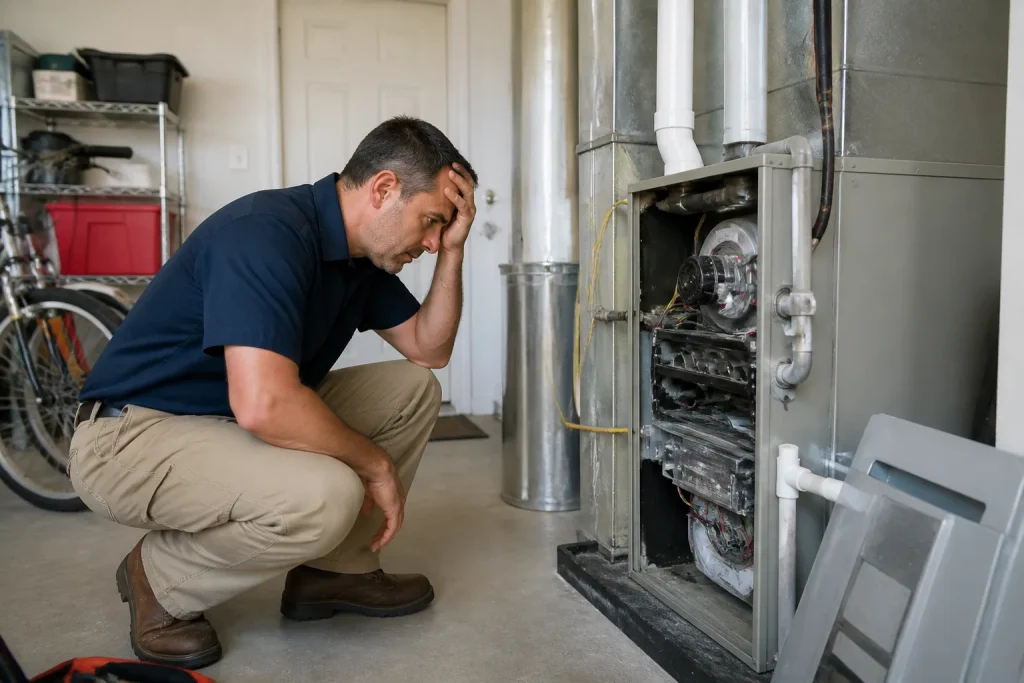
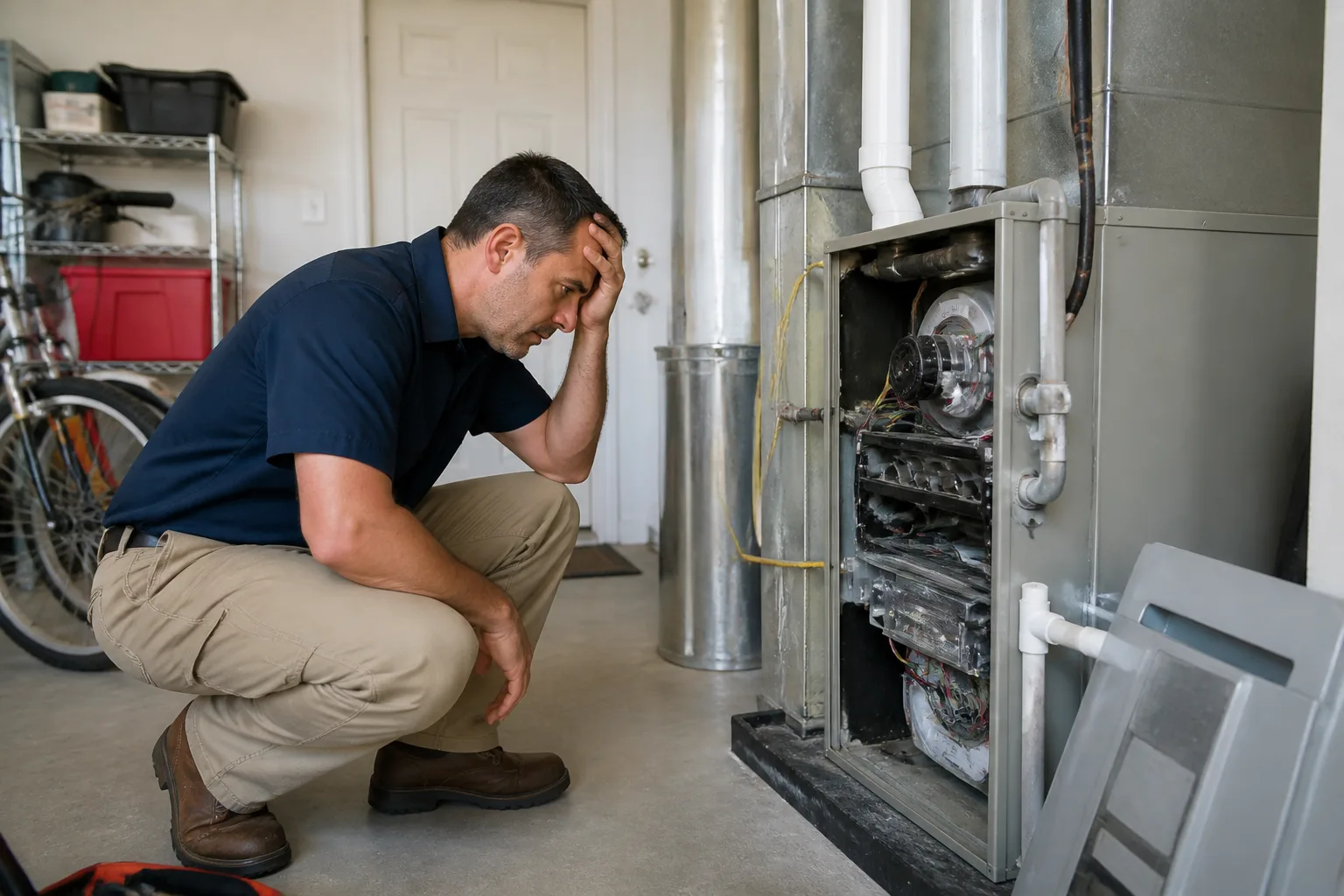
5 Mistakes to Avoid With Heating & Furnace
The most expensive furnace call of the year in Summerlin happens the first cold night, when a problem that existed in April finally announces itself at 10 p.m. The five mistakes below are the ones we see most often, and the good news is that none of them require a toolbox to prevent. A little attention in September, and a willingness to call when something sounds wrong, will save you a December repair bill and a night in a cold house.
If reading this makes you realize your system needs a look before the weather turns, call us at (888) 325-9387. A live person answers, day or night.
Key Takeaways
- Most furnace failures start in the off-season, not the first cold snap.
- A 20-minute pre-season check catches the problems that become emergency calls.
- In Summerlin’s short heating season, small problems quit being small fast.
- Gas valves and heat exchangers belong to licensed HVAC technicians, not handymen.
- A tune-up costs far less than the repair you skip it for.
1. Skipping the Pre-Season Firing Before the First Cold Snap
Most Summerlin furnaces sit idle from roughly April to November. That’s a long dormancy for a machine with a gas valve, a blower motor, and a heat exchanger. When you finally turn it on for the first cold night, you’re asking a system that hasn’t run in months to perform under load with zero warm-up. That’s where simple problems become late-night emergencies.
A pre-season check takes about 20 minutes and covers the things homeowners almost never look at:
- Flame sensor and igniter. A dirty flame sensor is one of the most common reasons a furnace won’t light. It’s a quick clean or replacement when caught early.
- Heat exchanger inspection. We look for cracks and corrosion that can let carbon monoxide into your home. This is the single most important safety check on any gas furnace.
- Blower motor and belt. Dust, age, and lack of use wear these down quietly.
- Gas connections and venting. We check for leaks and confirm the flue is clear and drafting correctly.
- Thermostat calibration. A thermostat that reads a few degrees off makes the furnace cycle harder than it should.
- Condensate line (on high-efficiency units). A clogged line here can shut the system down or cause water damage.
In Summerlin, where the heating season is short, this check matters more than it does in colder climates. You have fewer chances to notice a problem developing, so catching it before the season starts is your best shot at avoiding a mid-season breakdown. Our $89 seasonal tune-up covers exactly this kind of inspection, and you get a written report of what we actually found.
2. Blocking Return Air Vents During Cooling Season and Forgetting to Unblock Them
Summerlin summers are long and hot, and most of us rearrange furniture to chase the shade or fit a couch where it works. That’s fine until the couch, bookcase, or bed ends up in front of a return air vent. Blocked returns starve the system of airflow, and that strain doesn’t stop when cooling season ends.
Here’s the part most homeowners miss: a return vent you blocked in June is still blocked in November. The furnace then runs against the same restricted airflow, and restricted airflow is hard on a furnace. It overheats the heat exchanger, trips the high-limit switch, and shortens the life of the blower motor.
Before heating season starts, walk through your Summerlin home and check every return vent:
- Move furniture at least a few inches clear of any return grille.
- Check closets and hallways, where returns are easy to forget.
- Make sure rugs and curtains aren’t covering floor or wall returns.
- Vacuum the grilles; dust buildup restricts flow just like furniture does.
It sounds almost too simple to matter. In our experience, restricted airflow is behind a surprising share of the “it just stopped working” calls we get every fall.
3. Ignoring Short-Cycling Because “It Still Heats”
Short-cycling is when your furnace turns on, runs for a short time, shuts off, and repeats. Homeowners often let it go because the house still gets warm. Don’t. Short-cycling is the furnace telling you something is wrong, and in Summerlin’s low-demand winters, it accelerates into a full failure faster than you’d expect.
Why does it get worse here? Because our heating season is short, a furnace in Summerlin might only run 50 to 60 days a year. Each short cycle is one of a limited number of starts, and every one of them puts wear on the igniter, the flame sensor, and the control board. You’re burning through a season’s worth of ignition cycles in a fraction of the time a colder climate would.
Common causes of short-cycling include:
- A clogged or high-restriction air filter
- A failing flame sensor or dirty igniter causing intermittent ignition
- A thermostat that’s miscalibrated or placed in a bad spot
- An oversized furnace that heats the space too fast
- A restricted heat exchanger or venting problem
If your furnace clicks on and off in short bursts, that’s the moment to call. An intermittent ignition problem is usually a modest repair when it’s caught early. Left alone, it turns into a no-heat call on the coldest night of the year. We’re trained to service Rheem, York, Daikin, Bryant, and the other major brands, so we can diagnose it quickly.
4. Using the Wrong Filter MERV Rating for a Low-Runtime System
Filter shopping is where a lot of well-meaning homeowners accidentally hurt their furnace. The instinct is to buy the highest filtration rating on the shelf. For a furnace that only runs a couple of months a year, that instinct backfires.
MERV ratings measure how well a filter traps particles, but higher MERV also means higher airflow restriction. A furnace designed for a MERV 8 filter can struggle against a MERV 13, and that restriction is exactly what causes overheating, short-cycling, and premature blower wear. In Summerlin, where your furnace runs for a short season, a high-restriction filter sitting in the return all year can do quiet damage before you ever notice a problem.
A few practical guidelines:
- Check your system’s recommended MERV rating in the manual or on the unit, and don’t go far above it.
- Change the filter before heating season, not just during cooling season, since dust builds up year-round.
- Check it monthly during heavy use and replace it when it looks gray and matted.
- Ask us if you’re unsure. We’ll tell you the right rating for your specific system, which is cheaper than guessing.
If you want cleaner air, a whole-home air quality solution is a better fit than an oversized filter. A filter that’s too restrictive is one of the easiest furnace mistakes to avoid, and one of the most common ones we see in Summerlin.
5. Calling a General Handyman for Gas Valve or Heat Exchanger Work
This is the one that worries us most. Gas valves and heat exchangers are the two components on a furnace you should never hand to a general handyman, no matter how capable they are with a hammer. The safety and liability gap here is bigger than most homeowners realize.
Nevada requires HVAC work involving gas connections and heat exchangers to be handled by a licensed HVAC technician. A cracked heat exchanger can leak carbon monoxide into your home, and a gas valve that’s improperly serviced is a fire and health hazard. This isn’t about being territorial about the work; it’s about what happens if something goes wrong.
Beyond safety, there’s liability. If an unlicensed worker touches your gas system and something fails, your homeowner’s insurance may not cover the damage, and you may be left holding the bill. A handyman who “took a look” at your heat exchanger isn’t the person you want standing behind that work when it matters.
When we inspect a furnace, we check the heat exchanger for cracks, confirm the gas connections are sound, and test for carbon monoxide. Our technicians are background-checked and trained as journeymen, and every job is backed by our 90-Day Done Right Promise in writing. When gas is involved, choose a licensed HVAC professional. It’s not a conversation worth having after the fact.
When to Call a Pro
Some things are worth a phone call rather than a guess. Call us if you smell gas, hear clicking without ignition, notice short-cycling, or haven’t had your furnace checked since last season. If your system is aging and you’re weighing repair against replacement, we offer a free second opinion on any written estimate. For a closer look at what we do, see our Heating & Furnace in Summerlin service page, and for year-round comfort, our AC Repair & Installation in Summerlin page covers the cooling side of the same system.
The Bottom Line
Most Summerlin furnace failures aren’t sudden. They’re the result of a skipped pre-season check, a blocked return vent nobody moved, a short-cycling furnace that “still heated,” the wrong filter, or a gas repair handed to the wrong person. Each of those mistakes is preventable, and preventing them costs a fraction of fixing them.
Get your furnace looked at before the first cold night, not after. If you’re in Summerlin and need help, Fireside Heating & Air Co. Summerlin offers free estimates. Call (888) 325-9387. A live person answers every call, 24 hours a day. The price we quote is the price you pay, and if we don’t do it right, we make it right, in writing.
Frequently Asked Questions
Once a year, ideally in early fall before the first cold snap. Because Summerlin’s heating season is short, an annual pre-season check is the best way to catch problems that develop while the system sits dormant through the long cooling season.
Yes. Short-cycling signals a problem, whether it’s restricted airflow, a dirty flame sensor, or an ignition issue. It usually gets worse, and in Summerlin’s short heating season it can turn into a no-heat call quickly. Call (888) 325-9387 for a free estimate and we’ll diagnose it.
No. Gas valve and heat exchanger work requires a licensed HVAC technician in Nevada. These components involve carbon monoxide and fire safety, and unlicensed work can also put your insurance coverage at risk. Call us at (888) 325-9387 if you need this checked.
Not necessarily. A filter with a higher MERV rating restricts airflow more, which can strain a furnace that only runs a short season. Stick with the rating your system was designed for, and call (888) 325-9387 if you’re unsure which filter fits your unit.
For the full picture of what we do across the valley, visit our Fireside Heating & Air Co. Summerlin home page, and if you’re considering a system that heats and cools more efficiently, see our Heat Pump & Mini Split in Summerlin page.
Written by the team at Fireside Heating & Air Co. Summerlin.
Need HVAC Help?
Call Fireside Heating & Air Co. Summerlin - licensed & insured, here with fast after-hours help in Summerlin.
(888) 325-9387