
Air Quality & Ventilation: Repair or Replace? How Summerlin Homeowners Decide
Here’s the uncomfortable truth about air quality in Summerlin: a new purifier won’t fix a ventilation system that’s already moving contaminated air more efficiently than it should. Tight desert construction traps dust and keeps it cycling through your ducts. Most homeowners who call us about air quality don’t have a purifier problem – they have a ventilation problem wearing a purifier mask. If you’d rather not sort through it yourself, call (888) 325-9387 and we’ll take a look at the whole picture.
Key Takeaways
- Summerlin’s tight building envelope means air quality problems compound faster than in older, draftier neighborhoods.
- Alkali dust and PM2.5 from nearby development wear air handler components differently than typical urban dust.
- A component failure is repairable. A system design problem isn’t – and no new equipment fixes it.
- ERV and HRV cores can often be cleaned and rebalanced; sometimes the efficiency loss is permanent.
- Before recommending any air quality equipment, we test the building envelope and duct leakage first. Most IAQ vendors skip that step.
Why Summerlin’s Tight Construction Makes Air Quality Problems Worse
Summerlin homes are built to seal. That’s a good thing for your summer cooling bill and a complicated thing for your lungs. When a house holds its air that well, whatever gets inside stays inside and cycles through the system again and again. In looser construction, dust and VOCs leak out through gaps. In Summerlin, they don’t – they concentrate.
We pulled a return duct loose in a garage over in The Ridges last month and found a filter that had gone nearly gray with fine alkali dust in under four months. The homeowner had been running a standalone purifier in the bedroom and wondering why it wasn’t helping. The purifier was working. The ventilation was working too – efficiently moving the same contaminated air through the house.
That’s the piece most folks miss. A sealed home doesn’t give contamination anywhere to go. Your air handler becomes the circulation engine for whatever’s in the air, and the more efficient the system, the more thoroughly it spreads the problem. If you want to understand how your Summerlin system was built to move air, our Summerlin home HVAC team can walk you through it.
How Summerlin’s Desert Dust Is Different (And What It Does to Your System)
Not all dust is the same, and HVAC engineers who work in wetter climates sometimes assume the wrong thing. Here’s what we see in Summerlin:
- Alkali particles. The desert floor around the valley carries alkaline dust, and it’s more abrasive than typical household dust. It scours blower wheels and evaporator coils faster than you’d expect from a filter’s appearance.
- PM2.5 from surrounding development. Construction dust from new neighborhoods – and there’s a lot of it around Summerlin’s edges – has a high fine-particulate fraction. Those particles get past standard MERV-8 filters and settle on coils and in duct runs.
- Silica fines. Fine sand that feels like powder to the touch finds its way into return plenums and cabinet seams. It’s small enough to bypass cheap filtration and coarse enough to clog a coil’s fins.
What that means practically: standard 1-inch filters are undersized for Summerlin dust loads. A 4- to 5-inch media filter or a proper MERV-11 to MERV-13 setup handles alkali fines far better and costs less over a decade than repeated coil cleanings. We’ve seen Goodman and Rheem air handlers in Sun City Summerlin clogged in three summers that would’ve gone six or seven in a milder dust environment. That’s not a brand issue – that’s what the local dust load does.
Component Failure vs. System Design Problem: Know the Difference Before You Spend
This is the single most expensive mistake we see Summerlin homeowners make: replacing equipment to solve a design problem. They’re not the same thing, and the fix isn’t the same either.
A component failure is a specific part that wore out or failed. A blower motor that’s seized. A damper stuck closed. An ERV core that’s fouled. Fix the part, the system works.
A system design problem is when the system was set up wrong, or the home has changed since it was installed. Return air undersized. Supply registers in the wrong spots. Duct runs leaking 25% of their air into the attic. An ERV sized for a 2,000-square-foot home crammed into a 3,200-square-foot Summerlin house. New equipment doesn’t fix any of that – it just makes the wrong design newer.
How to tell? Diagnostic numbers, not guesses. Static pressure, duct leakage, return air sizing, envelope infiltration rate. If a contractor quotes you a new system without measuring any of those, they’re guessing.
ERV and HRV Cores: When Cleaning and Rebalancing Works, When It Doesn’t
Energy Recovery Ventilators and Heat Recovery Ventilators are the heartbeat of ventilation in a well-sealed Summerlin home. They bring in fresh air while exchanging heat with outgoing air, which matters when it’s 108 outside. The question we get most: clean it or replace it?
Here’s how we decide:
- Clean and rebalance if the core is intact, the filters are the only fouled part, and airflow measurements show the unit is within spec after cleaning.
- Clean, then re-evaluate if you’re seeing reduced efficiency but no physical damage. About half the ERV cores we open in Summerlin just need servicing once and they’re back to full exchange efficiency.
- Replace the core if the exchange medium has degraded – clogged beyond cleaning, physically damaged, or if testing shows the sensible and latent recovery has dropped permanently. Weep holes blocked in a Lennox ERV core that sat through a decade of desert dust aren’t coming back.
What most folks don’t realize: a badly fouled ERV can be worse than no ERV at all. It moves air without recovering heat, which means you’re pulling 108-degree air into a tightly sealed house without the exchange benefit. If your Trane or Lennox unit’s core is that far gone, cleaning it is a waste of money.
Reading Your IAQ Test Results Against Your Home, Not EPA Averages
A home air quality report comes back with numbers. Most people compare them to EPA averages and either panic or shrug. Neither is helpful. What matters is how the numbers compare to what’s expected in your specific Summerlin home.
Here’s what we look at when interpreting results:
- Construction vintage. A 2004 Summerlin build has different envelope leakage than a 2019 build. The same PM2.5 reading means something different in each.
- Duct design. If the ducts leak 20% of supply into the attic, every reading inside the house is skewed by pulled-in attic air – not what’s actually in your living space.
- Occupancy and activity. A house with two adults and no pets has different baselines than a house with three kids and a golden retriever.
- HVAC runtime. A system that runs 20 minutes a day isn’t moving air enough to keep CO2 down. A system that runs constantly is moving contaminated air constantly.
Context changes the answer. A VOC reading that looks alarming against EPA’s national average can be normal for a Summerlin home with a new wood floor and a recent paint job. The test is a starting point, not a verdict.
What We Check Before Recommending Any Air Quality Equipment
This is where most air quality vendors stop short. They test the air, recommend a purifier, and walk. We don’t recommend a dollar of air quality equipment until we’ve measured the building envelope and the ducts – because the equipment only works if the house’s ventilation and containment are doing their jobs first.
Our evaluation before any IAQ recommendation includes:
- Blower door test for envelope leakage and whole-home air changes per hour
- Duct leakage diagnostics – including a pressure pan test at every register
- Return air sizing and static pressure across the air handler
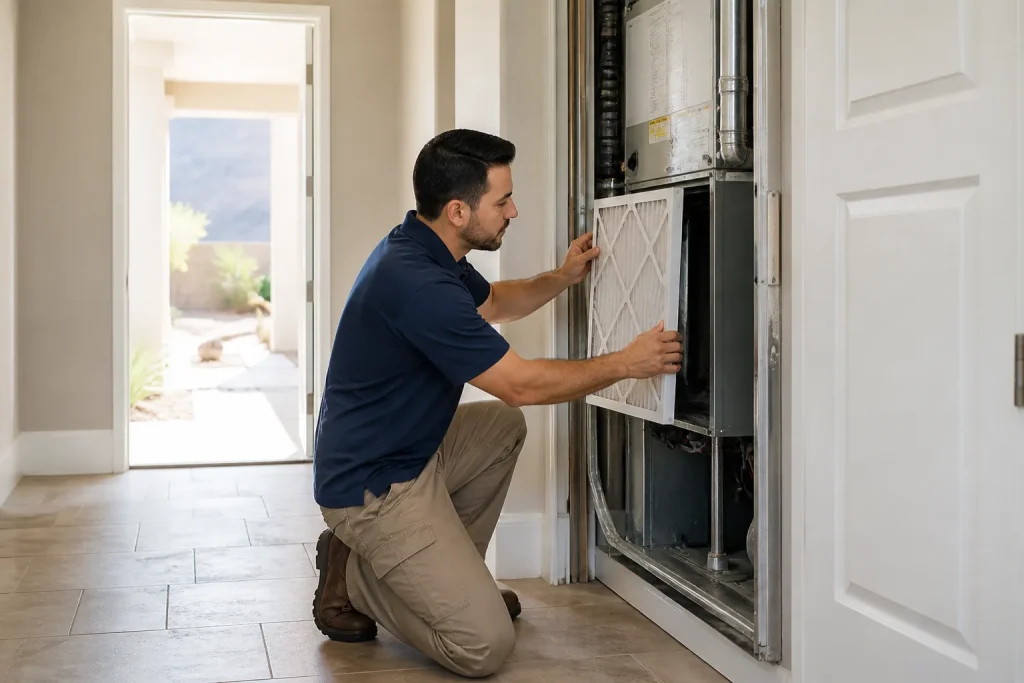
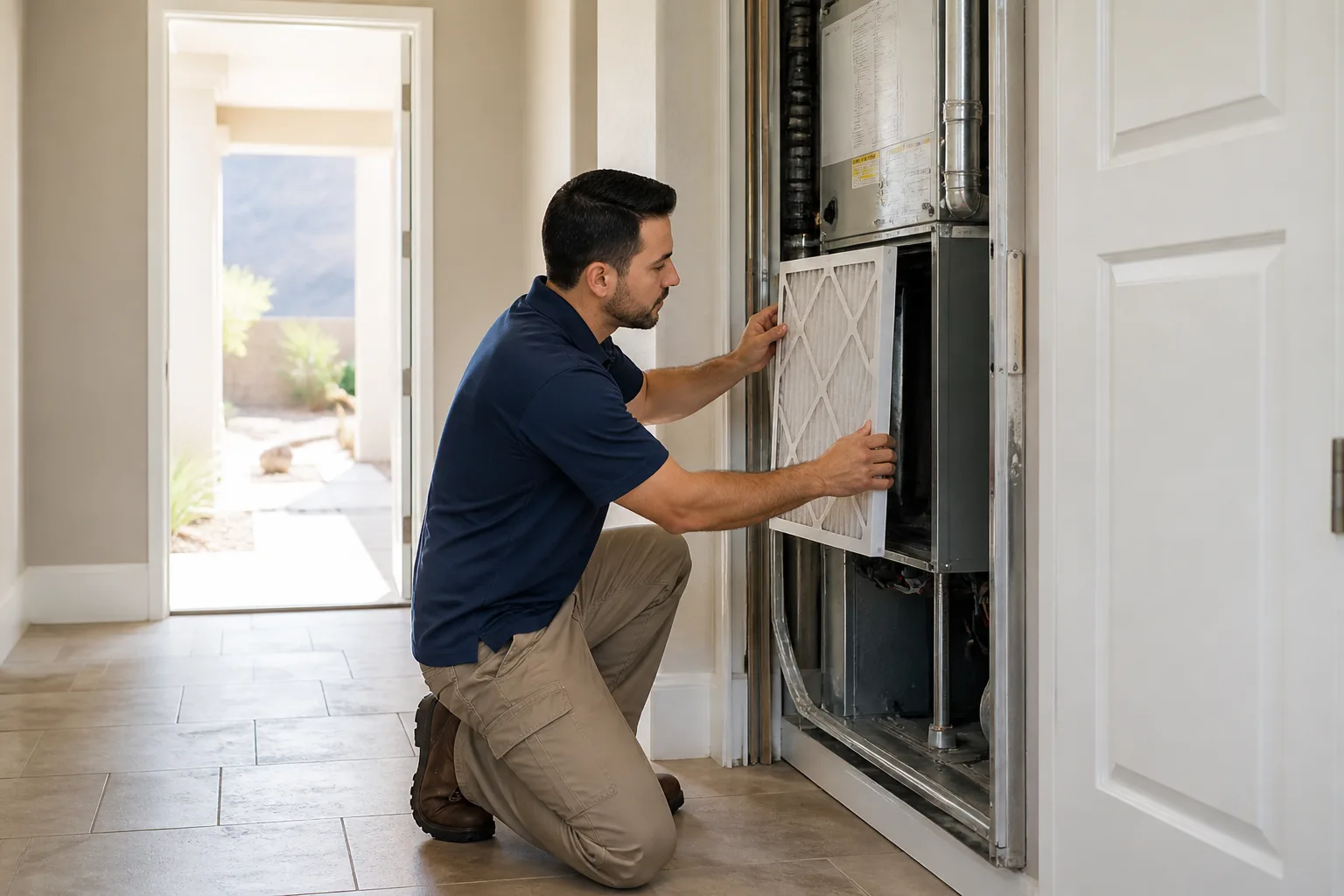
- Filter setup evaluation (depth, MERV rating, and cabinet capacity)
- ERV/HRV inspection and airflow verification
- Duct design review – are the runs right for how the home actually lives
Without those numbers, we’re selling you a filter with a marketing budget. With them, we can say with some confidence whether the fix is cleaning, rebalancing, sealing the ducts, or replacing a genuinely failed component. If it’s heating or cooling we’re evaluating alongside the air quality piece, our AC repair and installation services in Summerlin, our Summerlin heating and furnace services, and our Summerlin heat pump and mini split services are the natural complements.
When to Call a Pro
If you’re seeing persistent dust trails on your registers, pressure headaches in a sealed room, condensation on interior windows you didn’t have before, or guests mentioning “something” about the air – call us. These are all signs of a ventilation system doing damage it wasn’t meant to do. This is diagnostic work, and the wrong answer is more expensive than the right call. Don’t guess, and don’t buy a purifier until you know what the system is doing.
Our technicians have up to 8 years of experience on the diagnostics side, and they work from a checklist, not a sales script. Every job is backed by our 90-Day Done Right Promise: if it’s not done right, we make it right – in writing, no arguing. Calls are answered by a live person 24 hours a day, and if we need to come back out for the same issue, we’ll be there when we say we will. Current standing offers: $50 off any repair over $250, a free second opinion on any written estimate, an $89 seasonal tune-up, and a permanent 5% discount for seniors and veterans.
The Bottom Line
The repair-versus-replace call in Summerlin comes down to two questions: is the problem a failed component or a design flaw, and are the numbers from testing actually pointing where you think? Alkali dust, tight envelopes, and undersized filters all push you toward needing a proper diagnostic before any money moves. Purifiers and new equipment are good answers – but only when the ventilation and ductwork underneath them are healthy.
If you’re in Summerlin and want straight talk about what your system actually needs, Fireside Heating & Air Co. Summerlin offers free estimates – call (888) 325-9387. We’ll answer, look, and tell you what we see – repair, replace, or leave it alone until something changes.
Frequently Asked Questions
Only if the problem is actually airborne contamination your current system isn’t filtering – and in most Summerlin homes, it isn’t. A purifier won’t fix duct leakage, an undersized ERV, or an envelope that’s trapping contaminated air. Test the envelope and ducts first. Call (888) 325-9387 to schedule a free diagnostic.
Plan to clean and inspect every 12 to 18 months given Summerlin’s dust load. Most cores last 8 to 12 years before replacement, but a home near active development can shorten that considerably because the fine PM2.5 fraction accelerates fouling. If airflow drops and cleaning doesn’t restore it, replacement is the honest answer.
Not on air quality alone. Replacing an air handler with a better filter setup can help, but if the ducts leak or the returns are undersized, the improvement is limited. Fix the design first – that’s where the gains come from. Call us at (888) 325-9387 and we’ll test before we quote.
Tighter construction. Your new home seals well, which is energy-efficient but means contaminants concentrate instead of leaking out. A properly balanced ERV and a correctly sized filtration system solve it – the answer isn’t to open windows and hope. That’s a diagnostic conversation, and the call is free.
Written by the team at Fireside Heating & Air Co. Summerlin.
Need HVAC Help?
Call Fireside Heating & Air Co. Summerlin - licensed & insured, here with fast after-hours help in Summerlin.
(888) 325-9387