
5 Mistakes to Avoid With Heat Pump & Mini Split
The most common mini split problem call we get isn’t a failed unit. It’s a perfectly functioning unit installed in the wrong spot that has never worked right. In Summerlin, most of these mistakes happen on day one and stay invisible until year four or five, when the compressor quits and the homeowner blames the equipment instead of the install. Here are the five we see most, and how to avoid each one.
1. Mounting the Outdoor Unit on a West-Facing Wall With No Shade
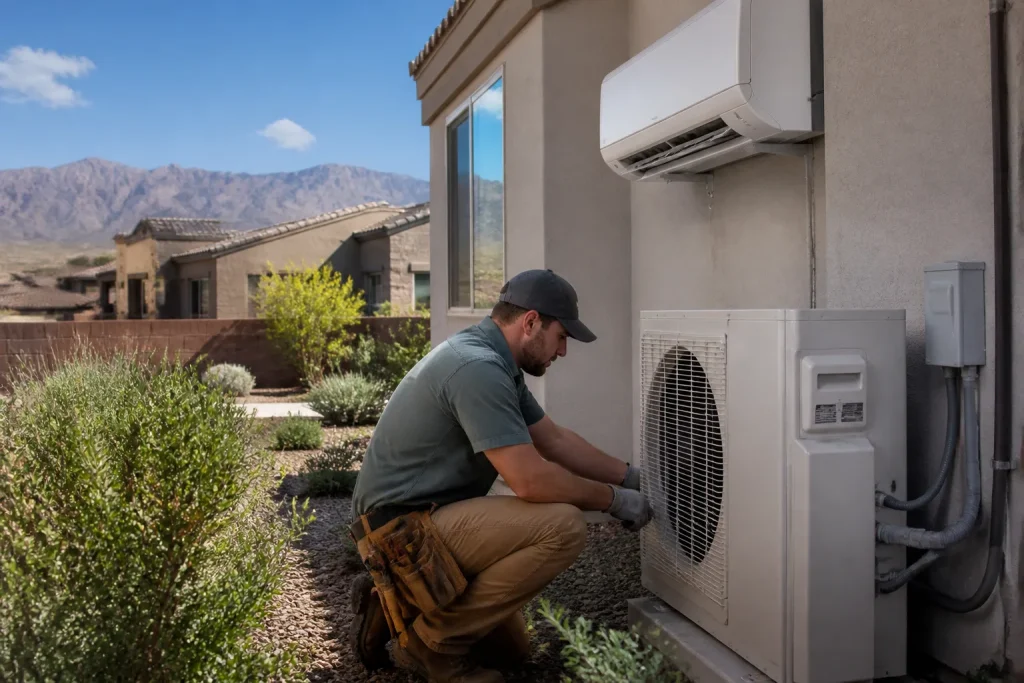
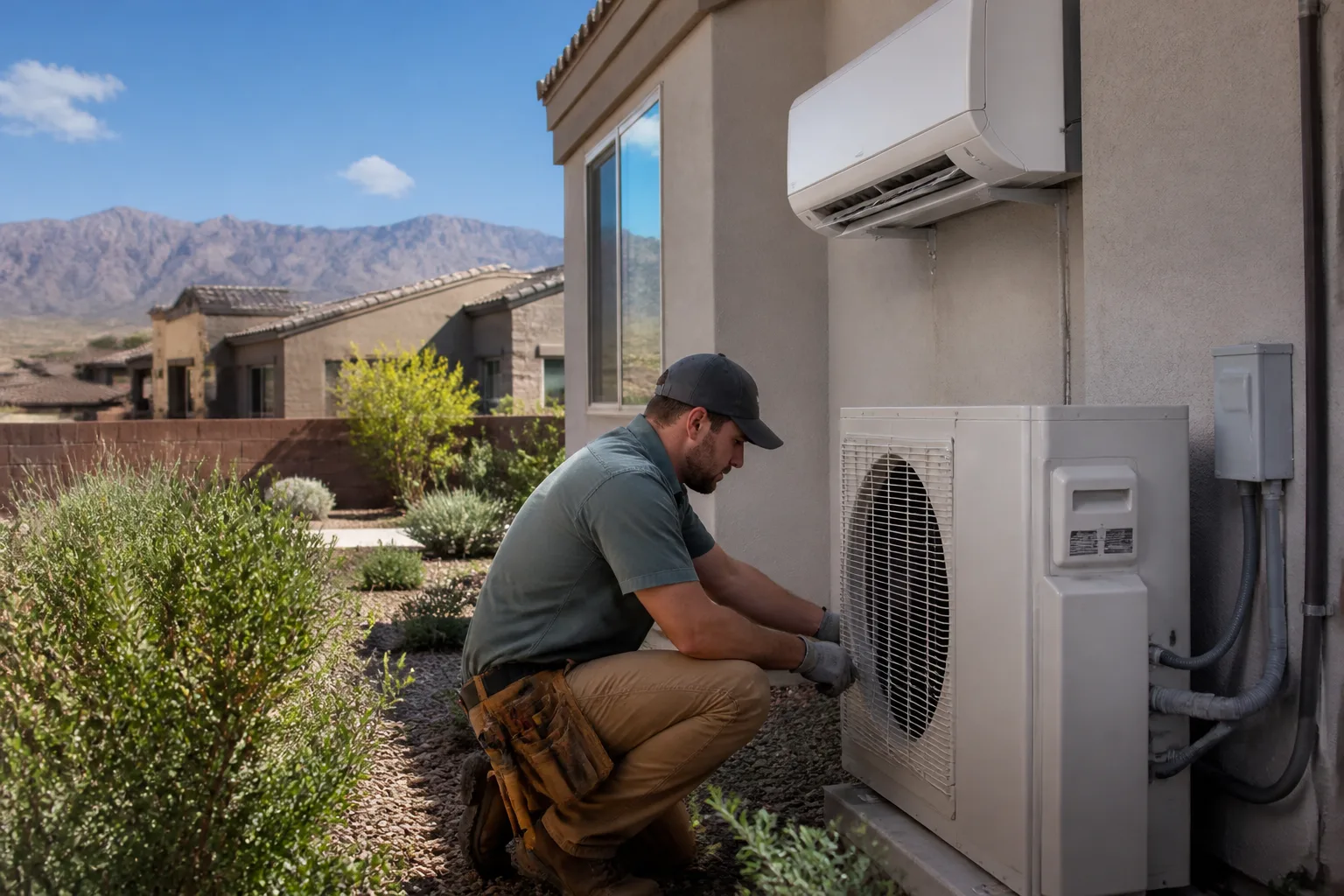
Summerlin summers push the outdoor unit hard. A west-facing wall gets the worst of it: full afternoon sun, radiant heat off stucco, and reflected heat off pavers or rock landscaping. When an installer sets the condenser tight against that wall with no clearance and no shade, the unit pulls its own hot exhaust back in and stacks ambient heat on top of an already hot day.
A compressor that should see normal head pressures spends July and August running hotter than it should. It still cools. That’s what makes it sneaky. You don’t notice anything wrong until the compressor fails early or the system starts tripping on high-pressure lockout during the hottest week of the year.
What a correct install looks like in Summerlin:
- At least 12 inches of clearance on the sides and 24 inches in front of the fan discharge, per manufacturer spec
- Shade from a wall, an awning, or a north or east wall whenever the layout allows it
- The unit elevated off the pavers or gravel so air moves underneath, not trapped in a heat pocket
- Not buried in a narrow side yard where hot discharge air has nowhere to go
If your outdoor unit already sits on a sun-baked west wall, a simple shade screen or a repositioned pad often solves the problem without replacing anything. That’s the kind of thing we look at during a tune-up before it turns into a compressor replacement.
2. Undersized Linesets and Too Many Bends
The lineset is the pair of copper lines that carries refrigerant between the indoor head and the outdoor unit. It doesn’t get talked about much because it’s hidden in the wall. But in Summerlin, it matters more than the spec sheet suggests.
Here’s why. A mini split moves a fixed charge of refrigerant through those lines. Every bend adds a small restriction. Every extra foot beyond the manufacturer’s stated maximum line length costs a little capacity. An installer working fast might shorten or lengthen the run, add a hard 90-degree elbow where a sweeping bend would do, or reuse a lineset sized for something else. On a mild day in a moderate climate, the system tolerates it. In Summerlin, where the outdoor unit is already fighting 110-degree afternoons, that extra restriction shows up as a system that never quite reaches setpoint in a back bedroom, or runs longer cycles than it should.
A proper install uses the manufacturer’s specified line size for that exact model, keeps the run as short and direct as the layout allows, uses sweeping bends over tight elbows, and pressure-tests the lines before charging. If a quote doesn’t mention line sizing or line length, ask. It’s a fair question.
We had a homeowner in The Ridges whose third bedroom never cooled right for three summers. Turned out it was a lineset problem from the original install, not the unit. Fixed the line routing and the bedroom finally kept up. That’s a Summerlin call we see more than you’d think.
3. Skipping Annual Coil Cleaning on the Indoor Head
Summerlin dust is not the same as dust in a humid climate. It’s fine, dry, and it carries construction particulate from the constant new build and remodel activity, plus windblown desert grit. That combination packs onto the indoor coil’s fins and the blower wheel in a way that humid-climate dust doesn’t. It sticks, it cakes, and it doesn’t blow out on its own.
When the evaporator coil is fouled, airflow drops. When airflow drops, the coil runs colder than it should and starts to ice. The system short-cycles, the blower motor works harder, and the whole thing runs less efficiently than it did the day it went in. A dirty indoor head in Summerlin can lose a noticeable chunk of capacity by the second or third season.
Once a year, the indoor head needs the filter cleaned or replaced and the evaporator coil cleaned. If you’re in a newer Summerlin neighborhood with active construction nearby, that filter cleaning might need to happen every two or three months during build season. It’s the single cheapest maintenance item on a mini split, and the most skipped.
4. Pairing a Mini Split With the Wrong Thermostat or Controller
Mini splits use an inverter compressor. It doesn’t just switch on and off. It ramps up and down to match the load, which is why it runs so efficiently and so quietly. That efficiency depends on the system’s own control logic running the show.
Homeowners sometimes add a third-party smart thermostat or an aftermarket external controller thinking it will add convenience. A controller that cycles the system on and off like a conventional furnace defeats the inverter. The compressor ends up short-cycling, the efficiency gains disappear, and in some cases the manufacturer treats the aftermarket controller as an unapproved modification that can affect the warranty.
The safer approach in Summerlin:
- Use the manufacturer’s own wireless remote and wall controller that came with the system, or a manufacturer-approved thermostat
- If you want smart-home integration, check with the installing contractor first that the specific controller is approved for that brand and model
- Keep the original controller handy. It’s the one the system was designed to work with
Mini splits from Bryant, American Standard, and Carrier all have their own approved controls. It’s worth five minutes of checking before you buy a gadget that fights the system.
5. Assuming “Ductless” Means Maintenance Is Optional
This one is the most expensive mistake in the list. A mini split has no ducts, so the thinking goes, there’s nothing to maintain. That’s not how it works.
There are service points on a mini split that only a trained technician can get to, and they need attention before year three:
- Refrigerant charge check. A slow leak from a flare fitting can go unnoticed for a year. A technician with gauges catches it before it kills the compressor.
- Condensate drain line. The indoor head produces water. That drain line clogs with dust and biofilm. When it does, water backs up, and in Summerlin we’ve seen it stain ceilings and drywall. A technician flushes it during service.
- Electrical connections and capacitor health. Heat stresses terminals and capacitors. Loose connections cause voltage drop that shortens compressor life.
- Deep coil cleaning. A homeowner can clean the filter. Cleaning the evaporator coil properly requires opening the head unit and using the right coil cleaner.
- Outdoor unit fan and coil cleaning. Summerlin dust and cottonwood fluff pack the outdoor coil. Left alone, head pressures climb.
Homeowners who skip all of this past year three are the ones calling us in year five for a compressor or a full replacement. Homeowners who get an annual tune-up get ten to fifteen years out of a system that never gave them a problem.
When to Call a Pro
Filter cleaning is a homeowner job. Everything else on a mini split, from refrigerant work to coil cleaning to controller setup, is not. Refrigerant lines are under pressure, and mishandling them is a safety issue and a warranty issue at once. Weighing a tune-up against a compressor replacement isn’t close, either.
If you have a mini split in Summerlin that’s never quite kept up, or one that hasn’t been serviced in two or three years, that’s worth a look before summer.
Related services in Summerlin: Whether you need heat pump & mini split service in Summerlin, AC repair and installation in Summerlin, or heating and furnace work in Summerlin, our team handles it. If you’re starting fresh, you can also read more about Fireside Heating & Air Co. Summerlin first.
The Bottom Line
Almost every mini split problem we see in Summerlin traces back to a decision made on install day: where the outdoor unit went, how the lineset was run, which controller was paired with it, and whether anyone committed to keeping it clean. Get those right and the equipment does what the spec sheet promised. Get them wrong and no brand name will save it.
Our technicians have up to 8 years of experience, work on nine major brands including Bryant, American Standard, Carrier, and Trane, and every job we do is backed by the 90-Day Done Right Promise: done right, or we make it right, in writing. If you’d rather not sort this out yourself, we answer the phone with a live person 24 hours a day, and the price we quote is the price you pay.
If you’re in Summerlin and need help, Fireside Heating & Air Co. Summerlin offers free estimates. Call (888) 325-9387.
Frequently Asked Questions
Once a year, minimum, with filter cleaning every two to three months if you live near active construction. The indoor coil, drain line, refrigerant charge, and outdoor coil all need a trained technician’s eyes at least annually. Summerlin’s dust load is heavier than most climates, so annual service isn’t optional here.
Usually placement, not equipment. An outdoor unit on a hot west wall with poor clearance, or a lineset that’s too long or too restricted, gets exposed in July and August. Sometimes an aftermarket thermostat is cycling the system wrong. A technician can diagnose which one in a single visit.
Only if the manufacturer approves that specific controller for your model. Inverter compressors need to run on their own control logic. A third-party thermostat that cycles the system like a conventional furnace will hurt efficiency and may affect your warranty. Check with your contractor before you buy.
Yes. A mini split that’s cooling well can still have a slow refrigerant leak, a clogging drain line, or a fouled coil that hasn’t caught up with it yet. An annual tune-up catches those early. The homeowners who skip it are the ones calling us in year five for a compressor instead of a service call.
Call (888) 325-9387 for an exact quote. Estimates are free, and a live person answers every time.
Written by the team at Fireside Heating & Air Co. Summerlin.
Need HVAC Help?
Call Fireside Heating & Air Co. Summerlin - licensed & insured, here with fast after-hours help in Summerlin.
(888) 325-9387